Guides · Grid-down
EMP and the power grid: the evidence, the dispute and your options
Federal commissions warn an EMP attack could darken a region for months or longer, utility researchers expect less, and households can do more about the outage than the pulse.
By PowerLockdown EditorialUpdated November 1, 20268 min readHow we research
In this guide
DisclosureAs an Amazon Associate we earn from qualifying purchases. We may earn a commission when you buy through links on this site, at no extra cost to you. Learn more.
At a glance
- What it is. A high-altitude electromagnetic pulse (HEMP) comes from a nuclear device detonated about 40 km or more above the Earth (Executive Order 13865, 2019). It is an attack scenario, not a natural event.
- The worst-case view. The congressionally chartered EMP Commission (2004) found an attack could degrade at least 70% of U.S. electrical service and that recovery could take "months to years." Its 2017 report said a nationwide blackout "could plausibly last a year or longer."
- The utility research view. EPRI's 2019 study found E1 could disrupt about 5% of digital protective relays (about 15% in a more severe case), expected no immediate widespread transformer damage, and found a multi-state regional blackout possible but not a years-long national one.
- The two sides disagree. Nobody has run the real experiment. We present both and pick neither.
- What you control. Your outage readiness: water, food, heat, light, comms and medicine for weeks. Shielding spare electronics is a small, cheap add-on with honest limits.
Three pulses, three different problems
The EMP Commission's 2004 executive report splits a nuclear EMP into three parts. Each hits different equipment.
| Component | What it is | What it threatens |
|---|---|---|
| E1 | A fast "electromagnetic shock" that rises in a fraction of a billionth to a few billionths of a second | Electronics-based control systems, sensors, communication systems, protective systems and computers |
| E2 | Similar to lightning | Generally not an issue for critical infrastructure on its own, but risky if E1 has already knocked out protection |
| E3 | A slower, longer pulse that drives disruptive currents in long transmission lines | Transformers and the high-voltage grid, much like a severe solar storm |
E3 behaves like a geomagnetic storm, which is why the two threats are often discussed together. Executive Order 13865 calls a geomagnetic disturbance "a type of natural EMP." Our solar storms guide covers that side, including real-world data from 1989 and May 2024.
What the EMP Commission found
Congress chartered the Commission to Assess the Threat to the United States from EMP Attack. Its reports are the source of most alarming EMP claims, and the findings are stark:
- 2004: An attack "may well encompass and degrade at least 70% of the Nation's electrical service." Functional collapse of the power system is "almost definite over the entire affected region," with "recovery times of months to years, instead of days to weeks."
- 2008: In simulated-EMP tests on control systems of the kind that run grid and industrial equipment (SCADA), "every system tested failed."
- 2017: A nationwide blackout "could plausibly last a year or longer." Generators, uninterruptible power supplies and renewable-energy components "are also vulnerable." The Commission said NERC's geomagnetic standards "substantially underestimate" disturbances and that no standards against nuclear or non-nuclear EMP weapons had been proposed or adopted.
The car and truck tests
The most concrete household-relevant data in the Commission's work comes from its 2008 vehicle tests. They are also the source of a common myth, that every car would die.
| Test | What was tested | What happened |
|---|---|---|
| Cars | 37 cars, model years 1986 to 2002, at field strengths up to about 50 kV/m | No effects in cars that were switched off. Engines stopped in 3 running cars at about 30 kV/m or higher; 1 needed dashboard repair; 25 showed nuisance effects; 8 showed none. |
| Trucks | 18 trucks, model years 1991 to 2003 | Trucks that were not running were unaffected. 3 running trucks stalled; 1 needed towing. |
| Expected effect, cars | Projection at higher field strengths | About 10% or more with serious effects, including engine stall |
The cars tested are now 24 to 40 years old, and modern vehicles carry far more electronics. The result that switched-off vehicles showed no effects is still the best public data point that unplugged, unpowered equipment fares better.
What utility researchers found
The Electric Power Research Institute (EPRI) summarized its EMP research in its journal in June 2019. Its conclusions point to a serious but smaller event:
- E1 could disrupt or damage about 5% of digital protective relays on transmission line terminals, or about 15% under a more severe E1.
- E1 is "unlikely" to cause an immediate interconnection-wide blackout.
- From E3, "immediate, widespread transformer damage is not expected," although a multi-state regional blackout is possible.
- No transmission damage is expected from E2.
- The findings do not support nationwide blackouts lasting years.
- Mitigations exist: shielded cables, surge protection, grounding, spare relays and transformers, and devices that block induced currents.
The 2017 Commission report anticipated this, saying it was concerned that DOE and EPRI were pursuing lengthy research that introduced "unnecessary delays." That dispute is unresolved.
What the federal government has done
DOE's EMP Resilience Action Plan (January 2017) set five goals with EPRI: improve understanding of EMP, identify priority infrastructure, test and promote mitigation, improve response and recovery, and share best practices. Executive Order 13865 (March 2019) made it policy to warn of an impending EMP and to protect against, respond to and recover from one. It set deadlines, including:
- DHS to list national critical functions within 90 days and assess the most vulnerable within a year.
- DOE to develop EMP waveform and intensity benchmarks within a year.
- Interior to complete a magnetotelluric survey of the contiguous U.S. within four years.
- DHS to report on technology options within a year and every two years after, and to run a pilot test of mitigation.
None of these steps tells a household when or whether the grid near them is hardened. Plan as if it is not.
What a household can do
You cannot protect the grid. You can control how long your household lasts without it, and you can keep a small set of spare electronics in better shape. In order of payoff:
- 01Build outage depth first. Water, food, heat, light, sanitation and medicine for weeks matter in every grid-down scenario, EMP or not. Start with the 30-day plan, then the 90-day plan.
- 02Store water you do not need to pump. Municipal treatment and pumping depend on power. See water when the taps stop.
- 03Keep food that needs no refrigeration. See long-term food storage.
- 04Plan heat without electronics. A wood stove or an indoor-rated propane heater with CO alarms, per heating without power.
- 05Keep a sanitation kit. EPA warns that utility power loss can cause sewage backups; see sanitation without power.
- 06Shield a small set of spares. A spare radio, a spare phone, a power bank, a flashlight. The CISA method is below.
- 07Have a non-cellular comms plan. See ham and GMRS radio.
Faraday storage, done the CISA way
CISA's EMP Protection and Resilience Guidelines (February 2019) list low-cost Level 1 measures. These are the parts that apply at home:
- Unplug power, data and antenna lines from spare equipment.
- Use lightning-rated surge protectors on what stays plugged in.
- Keep backup power that does not depend on the grid, with about one week of fuel on hand.
- Wrap spare electronics in aluminum foil or store them in Faraday containers. CISA's method: put the item in a plastic or paper bag or other insulating material first, then wrap it in heavy-duty foil with overlapping seams, two or more layers if possible.
- Do not count on Mylar food bags; CISA says they give "little protection."
- Do not count on an unmodified metal trash can. CISA says metal trash cans "do not usually provide reliable EMP protection" unless the gaps are sealed.
- A microwave oven can serve as an expedient Faraday cage, but test it first: put a phone inside and call it, or put a radio inside and listen. Never switch the oven on with equipment inside.
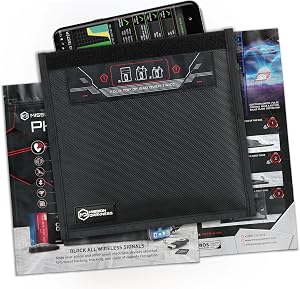
If you buy a bag, choose one whose maker publishes the standards it claims and how to seal it, and treat the EMP claim as the maker's claim. Our pick below is a phone-size bag whose manufacturer states certification to MIL-STD 188-125. Store a spare radio and power bank in it, or wrap them in foil per CISA, and keep them unplugged.
No. 1Faraday bag
Mission Darkness Non-Window Faraday Bag for Phones (MDFB-S-NW)
Best for: Shielding a spare phone or radio; one sealed layer of a layered plan
- Manufacturer states it blocks signals from low MHz to 40 GHz
- Two layers of TitanRF Faraday fabric, dual paired seams; ballistic nylon exterior
- Manufacturer states certification to MIL-STD 188-125 and IEEE 299-2006; no dB figure on the product page
- Interior 8.5 × 5 in; roll down twice, then hook-and-loop seal
Tradeoffs
- The product page states RF attenuation and standards, not EMP protection; no independent EMP data is published there
- Fits one phone-sized device, and a cable caught in the closure lets signals through (manufacturer)
No. 2Emergency radio
Kaito KA600 Voyager Pro Emergency Radio
Best for: Maximum power flexibility, plus shortwave
- Power: hand crank, flip-up solar panel, built-in rechargeable Ni-MH battery, 3 AA batteries, AC/DC adapter or a computer
- 7 pre-programmed NOAA weather channels with an Alert mode that switches the radio on for NOAA alerts
- AM / FM / longwave / shortwave bands
- Solar panel can run the radio even with no battery installed (manufacturer description)
Tradeoffs
- Larger than a pocket radio, and the AA batteries are not included.
- AC adapter sold separately or in a bundle

No. 3Power bank
Goal Zero Venture 35 Power Bank
Best for: Rugged, waterproof bank you can recharge from a solar panel
- 9,600 mAh / 35.52 Wh
- IP67 waterproof (1 m for 30 min, port door closed)
- USB-C PD 18W in/out plus USB-A out (15W)
- Solar recharge with Goal Zero Nomad 10 (about 6-12 hrs); USB-C about 3 hrs
- 50-lumen flashlight; 10.12 oz; operating range 32-113°F
Tradeoffs
- Small capacity for a whole household; Goal Zero says to recharge it every 3-6 months in storage
- 18W is too slow for most laptops; solar panel sold separately
Backup power is the hard part. The 2017 Commission report says generators and UPS units are also vulnerable, and no public data shows which consumer power stations would survive. A fuel-burning generator stored unplugged and a manual heat source are the conservative choices. Size what you need with the backup power calculator on BackupPowerAI, and see its generator safety guide: generators run outdoors only, at least 20 feet from the house.
What we don't know
- The size of the real event. The EMP Commission and EPRI reach different conclusions from different assumptions. No HEMP has been detonated over a modern grid.
- Whether consumer electronics survive. We found no authoritative public test data on unplugged modern phones, radios or power stations. The best evidence is indirect: switched-off cars in the 2008 tests showed no effects, and CISA calls handheld electronics relatively immune.
- How well Faraday bags work against a real pulse. Bag performance claims are manufacturer claims. CISA warns many bags are evidence-grade.
- How much hardening utilities have done. EO 13865 set federal deadlines, but there is no public map of which grid assets are protected.
- Modern vehicles. The vehicle tests covered model years 1986 to 2003.
Read alongside attacks on the power grid, which covers physical and cyber threats with far more incident data. Then work through the blackout checklist and the Blackout Kit.
Frequently asked questions
- Would an EMP take down the entire U.S. power grid?
- The EMP Commission (2004) said an attack could degrade at least 70% of U.S. electrical service and its 2017 report said a nationwide blackout could plausibly last a year or longer. EPRI's 2019 study found a multi-state regional blackout possible but did not support nationwide blackouts lasting years. The evidence is contested.
- Do Faraday bags protect against EMP?
- A well-made, properly sealed shielded enclosure reduces exposure, and CISA lists Faraday containers among low-cost measures. EMP performance claims on specific bags are manufacturer claims, and CISA warns many bags sold online are evidence-collection bags that may give only electrostatic protection.
- Will my car work after an EMP?
- In the EMP Commission's 2008 tests of 37 cars from 1986 to 2002, cars that were switched off showed no effects, and 3 running cars stalled at high field strengths. Modern vehicles were not tested, so nobody can say for certain.
- Does a metal trash can work as a Faraday cage?
- Not reliably. CISA's 2019 guidelines say metal trash cans do not usually provide reliable EMP protection unless they are modified to seal the gaps.
- What should I prepare first for an EMP?
- The same things that matter in any long grid-down outage: stored water, food that needs no refrigeration, safe heat, light, sanitation and medicine. Shielding a few spare electronics comes after those.
Sources
- EMP Commission, Report of the Commission to Assess the Threat to the United States from EMP Attack, Vol. 1: Executive Report, 2004.
- EMP Commission, Report of the EMP Commission: Critical National Infrastructures, April 2008.
- EMP Commission, Assessing the Threat from EMP, Executive Report (copy hosted by securethegrid.com), July 2017.
- Federal Register, Executive Order 13865, Coordinating National Resilience to Electromagnetic Pulses, March 29, 2019 (signed March 26, 2019).
- U.S. Department of Energy, DOE Electromagnetic Pulse Resilience Action Plan, January 10, 2017.
- CISA / National Coordinating Center for Communications, Electromagnetic Pulse (EMP) Protection and Resilience Guidelines for Critical Infrastructure and Equipment, v2.2, February 5, 2019.
- EPRI Journal, A "Deliberate Approach" to Electromagnetic Pulses, June 20, 2019.
- U.S. Environmental Protection Agency, Incident Action Checklist: Power Outages (water and wastewater utilities), 2019.
- U.S. Consumer Product Safety Commission, Carbon Monoxide Information Center, accessed October 27, 2026.
Related guides
Outage basics
How long power outages last: what federal data shows
What federal data says about outage length in the US, why a few big storms dominate the numbers, and how to decide how many days to prepare for.
Updated October 27, 2026 · 7 min read
Gear picks
Best emergency radios for power outages
Five research-based picks for hand-crank, solar and battery NOAA weather radios, chosen from manufacturer specs and published data.
Updated October 27, 2026 · 8 min read
Gear picks
Best carbon monoxide alarms for power outages
Generators, fuel-burning heaters and improvised cooking make outages a high-risk time for carbon monoxide. These alarms keep working without grid power.
Updated October 27, 2026 · 8 min read