Guides · Grid-down
Ham and GMRS radio keep a household talking when cell towers go dark
Cell networks depend on grid power and backhaul, so a long outage calls for radios that talk directly to each other, a license where the law requires one, and a written plan for when to listen.
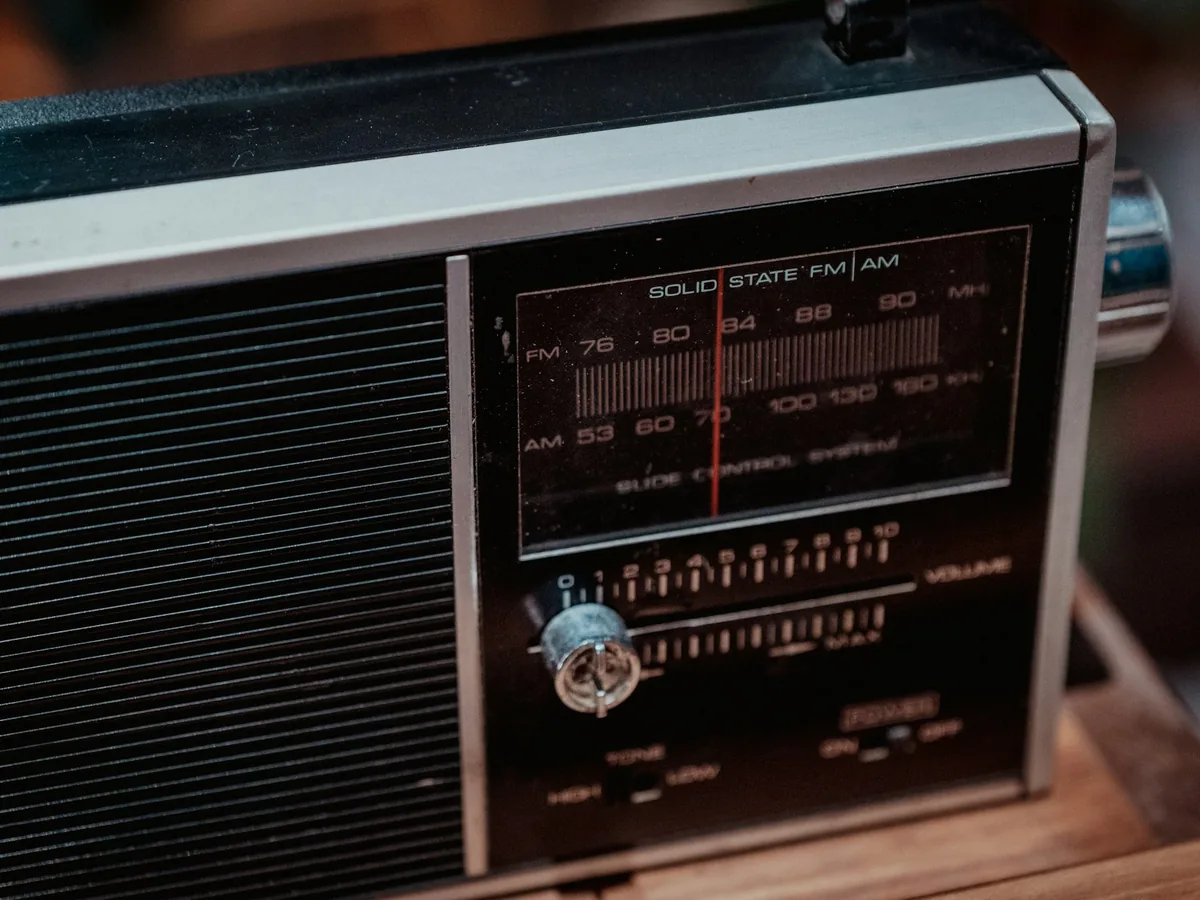
Photo: Sung Jin Cho / Unsplash
By PowerLockdown EditorialUpdated November 1, 20268 min readHow we research
In this guide
DisclosureAs an Amazon Associate we earn from qualifying purchases. We may earn a commission when you buy through links on this site, at no extra cost to you. Learn more.
At a glance
- Cell service is fragile in disasters. After Hurricane Helene, 48.7% of cell sites in the North Carolina disaster area were out on October 1, 2024 (FCC DIRS data).
- Radios that talk directly to each other (simplex) need no tower. Range depends on terrain, antenna height and power; repeaters extend it.
- FRS, MURS and CB need no individual license. GMRS needs an FCC license: no exam in the rule text, valid 10 years, covers immediate family.
- Amateur (ham) radio needs an exam, given by volunteer examiners. It opens more bands and organized emergency nets (ARES, RACES).
- Listening matters as much as talking. A NOAA Weather Radio receiver and an AM/FM radio keep you informed with no transmit license.
- Radios run on batteries. Plan charging from power banks, a power station or solar before you need it.
Why phones stop working in a long outage
A cell site needs electricity at the tower and a working link back to the network. Backup power at cell sites varies, and carriers rarely publish how long a given site can run. The FCC's Disaster Information Reporting System showed how fast that cushion runs out: on October 1, 2024, 21.7% of cell sites across the Hurricane Helene disaster area were out, up from 9.1% a day earlier. By state, 48.7% were out in North Carolina, 36.7% in Florida and 21.9% in Georgia.
Federal rules do not set a minimum battery runtime for cell sites. The FCC's Mandatory Disaster Response Initiative, effective October 31, 2022, requires mobile carriers to provide disaster roaming, mutual aid and public restoration updates, but the FCC deferred proposals on backup power. California is stricter: the CPUC requires 72 hours of backup power for wireless carriers in Tier 2 and Tier 3 High Fire Threat Districts. Outside rules like that, do not count on tower power lasting beyond the first days of a grid failure.
In a grid-down event lasting weeks, such as a severe solar storm or an attack on grid equipment, plan as if phones and internet will be gone after the first days.
What works without towers
- Simplex two-way radio. Handhelds and mobile radios transmit directly to each other. No infrastructure, only batteries.
- Repeaters. GMRS and amateur repeaters on hills or towers retransmit signals over a wider area. Many have backup power, but not all, so treat them as a bonus.
- NOAA Weather Radio. The National Weather Service runs more than 1,000 transmitters covering all 50 states, coastal waters, Puerto Rico, the U.S. Virgin Islands and the Pacific Territories, broadcasting around the clock on seven frequencies from 162.400 to 162.550 MHz. It carries all-hazards alerts, not only weather.
- AM and FM broadcast. Stations with generators remain the main channel for official instructions.
The radio services compared
The FCC's Part 95 Personal Radio Services are authorized by rule, so most need no individual license (47 CFR 95.305). GMRS is the exception within Part 95. Amateur radio sits under Part 97 and requires a license earned by exam.
| Service | License | Power limit (rule) | Best household use |
|---|---|---|---|
| FRS | None (licensed by rule) | 2 W ERP on channels 1–7 and 15–22; 0.5 W on 8–14 (95.567) | Short-range family talk, kids' radios |
| GMRS | FCC license, age 18+, 10 years, covers immediate family (95.1705) | Up to 50 W for mobile, base and repeater stations on main channels; 5 W ERP on 462 MHz interstitials; 0.5 W ERP handhelds on 467 MHz interstitials (95.1767) | Household and neighborhood net, repeater access |
| MURS | None (licensed by rule) | 2 W transmitter output (95.2767) | Property and farm use, quiet channels |
| CB | None (licensed by rule) | 4 W AM carrier; 12 W peak envelope power on SSB (95.967) | Road and vehicle communication |
| Amateur (ham) | Exam-based license, 10-year term (97.501, 97.25) | Set by license class and band | Regional nets, emergency service, long distance |
GMRS: the household workhorse
GMRS is the practical middle ground for families. Under 47 CFR 95.1705, an individual license is required to operate a GMRS station, and applicants must be at least 18. The license normally runs ten years, and the licensee may let immediate family members operate, including a spouse, children, grandchildren, parents, grandparents, siblings, aunts, uncles, nieces, nephews, in-laws and step-relations. The rule text contains no exam requirement. The FCC application fee for a new GMRS license is 35 dollars (47 CFR 1.1102). Anyone may transmit an emergency message.
Handhelds such as the Midland GXT67 PRO run 5 watts (manufacturer spec), and repeater-capable models can reach a local GMRS repeater for wider coverage. Mobile and base stations on the main channels may run up to 50 watts under 95.1767, which, with a roof antenna, is where GMRS starts covering a neighborhood instead of a yard.

GMRS radio
Midland GXT67 PRO 5-Watt GMRS Two-Way Radio
Best for: Household and neighborhood talk with repeater access
- 5 watts; repeater capable with 8 GMRS repeater channels and split tones
- Up to 99 GMRS/FRS channels (22 standard, 28 preset privacy-code, up to 49 user-defined)
- IP67 waterproof and dustproof
- NOAA weather alert; up to 4-day battery life, 4-hour rapid charge (manufacturer)
Tradeoffs
- Transmitting on GMRS requires an FCC license (47 CFR 95.1705); the manufacturer page does not say so
- Sealed battery is not user-replaceable
Amateur radio: more reach, more training
Ham radio takes more effort and gives more back. There are three license classes: Technician (exam Element 2), General (Elements 2 and 3) and Amateur Extra (Elements 2, 3 and 4), per 47 CFR 97.501. Exams are given by a team of at least three volunteer examiners at a session coordinated by a Volunteer Examiner Coordinator (97.509). Licenses normally run ten years (97.25), and the FCC application fee is 35 dollars (1.1102).
A Technician license is enough for a dual-band handheld on local VHF and UHF repeaters, which is where most local emergency nets operate. Higher classes add privileges on HF bands that can reach far beyond line of sight.
The organized side matters as much as the radio. ARRL's Amateur Radio Emergency Service (ARES) is made up of licensed amateurs who register their qualifications and equipment to provide communications when storms or other disasters damage critical communication infrastructure; ARRL membership is not required. The Radio Amateur Civil Emergency Service (RACES) carries civil defense communications, and its operators must be licensed and enrolled in a civil defense organization (47 CFR 97.407). Joining a local net before an emergency is how you learn which repeaters and frequencies your area actually uses.

Amateur radio
Yaesu FT-65R Dual-Band Handheld Transceiver
Best for: A first ham handheld for local repeaters and nets
- 2 m / 70 cm (VHF/UHF) dual-band FM
- 5 W / 2.5 W / 0.5 W output
- 1,950 mAh Li-ion battery rated for over 9 hours (manufacturer)
- IP54; MIL-810 C, D and E; weather alert scan
Tradeoffs
- Transmitting requires at least a Technician-class amateur license
- IP54 is splash resistance, not waterproof
A household radio plan
Radios without a plan produce silence or chatter. Write this on paper, put a copy with every radio and keep one in the Blackout Kit.
- 01Pick a primary channel and a backup. Write both down with any tone or code settings. Privacy codes filter what you hear; they do not make a conversation private.
- 02Set check-in times. For example, five minutes at the top of every third hour. Radios left off between check-ins last far longer on a charge.
- 03Set a meeting point for each family member in case radios fail or are out of range.
- 04List your local repeaters and nets (GMRS and amateur) once you know them, with their frequencies and tones.
- 05Note the NOAA Weather Radio frequency for your county and the AM/FM stations that carry emergency information.
- 06Practice monthly. Talk from the far end of your street, from inside a car, from a basement. You will learn your real range, which no spec sheet can tell you.
- 07License first. Get the GMRS license, and the ham license if anyone wants it, while the FCC's systems and exam sessions are running normally.
Listen-only gear
Everyone in the house can listen without a license. A hand-crank or solar weather radio keeps NOAA alerts and AM/FM news coming when the grid and phones are down. Our emergency radio guide and the Blackout Kit chapter on radios and power banks compare models.

No. 1Emergency radio
Midland ER310 Emergency Crank Weather Radio
Best for: A household weather radio with several ways to stay powered
- Power: solar, hand crank, 3,500 mAh rechargeable Li-ion, or 6 AA batteries
- NOAA weather band; alerts sound when issued on your local channel
- LED flashlight with SOS beacon
- USB output to top up a phone
Tradeoffs
- Midland notes the design dates to the early 2000s and may not charge newer phones (iPhone X and later) reliably. Weather alerts are not SAME county-coded.
- Midland's FAQ notes solar tops up a charged battery rather than reviving a dead one
- Micro-USB charging rather than USB-C

No. 2Emergency radio
Eton American Red Cross FRX2 (ARCFRX2WXW)
Best for: A simple, compact backup radio
- Power: hand turbine, solar, or mini-USB; 1,000 mAh internal Li-ion battery
- 1 minute of cranking gives 15 to 20 minutes of radio (manufacturer)
- AM/FM plus all 7 NOAA weather channels; digital display
- 3-LED flashlight, glow-in-the-dark locator, USB phone port, headphone jack; 0.56 lb
Tradeoff
- Small battery and no automatic weather-alert mode listed, so you have to tune in yourself.
No. 3Emergency radio
Kaito KA600 Voyager Pro Emergency Radio
Best for: Maximum power flexibility, plus shortwave
- Power: hand crank, flip-up solar panel, built-in rechargeable Ni-MH battery, 3 AA batteries, AC/DC adapter or a computer
- 7 pre-programmed NOAA weather channels with an Alert mode that switches the radio on for NOAA alerts
- AM / FM / longwave / shortwave bands
- Solar panel can run the radio even with no battery installed (manufacturer description)
Tradeoffs
- Larger than a pocket radio, and the AA batteries are not included.
- AC adapter sold separately or in a bundle
Keep the radios charged
Two-way radios draw little power, but weeks of use still need a charging plan. Keep a power bank per radio set, recharge rotating packs from a portable power station, and add a solar panel for anything longer than a week. Solar generator kits are compared on our sister site: best solar generator kits. Store spare AA or AAA batteries for any radio that takes them.

No. 1Power bank
Anker 737 Power Bank (PowerCore 24K)
Best for: High-capacity USB-C bank that can charge a laptop
- 24,000 mAh
- 140W max output
- 2× USB-C + 1× USB-A
- Smart digital display
- 630 g (22.22 oz)
Tradeoffs
- No solar input; recharge from wall or USB-C
- Heavy for a pocket

No. 2Power bank
Goal Zero Venture 35 Power Bank
Best for: Rugged, waterproof bank you can recharge from a solar panel
- 9,600 mAh / 35.52 Wh
- IP67 waterproof (1 m for 30 min, port door closed)
- USB-C PD 18W in/out plus USB-A out (15W)
- Solar recharge with Goal Zero Nomad 10 (about 6-12 hrs); USB-C about 3 hrs
- 50-lumen flashlight; 10.12 oz; operating range 32-113°F
Tradeoffs
- Small capacity for a whole household; Goal Zero says to recharge it every 3-6 months in storage
- 18W is too slow for most laptops; solar panel sold separately
What we don't know
We cannot tell you how long your local cell sites, repeaters or broadcast stations will stay on the air; backup power varies site by site and is rarely published. We also cannot tell you how well handheld radios would survive a high-altitude electromagnetic pulse. CISA's 2019 guidance says small handheld electronics are relatively immune unless long antennas or cords are attached, but that is not test data on any specific model. See EMP and the power grid for what the evidence does and does not show.
Communications are one part of a longer plan. See the 30-day grid-down plan, the 90-day plan, heating without power, water when the taps stop and sanitation without power, then print the blackout checklist.
Frequently asked questions
- Do I need a license for GMRS radios?
- Yes. 47 CFR 95.1705 says a valid individual license is required to operate a GMRS station. Applicants must be at least 18, the rule text has no exam requirement, the license normally lasts ten years, and immediate family members may operate under it. The FCC application fee is 35 dollars.
- Which radios can I use with no license at all?
- FRS, MURS and CB are licensed by rule under FCC Part 95, so individuals do not apply for a license. FRS is limited to 2 W ERP on channels 1–7 and 15–22 and 0.5 W on 8–14; MURS to 2 W; CB to 4 W AM or 12 W peak on SSB. Anyone may also listen to NOAA Weather Radio and broadcast stations.
- How hard is the ham radio Technician exam?
- The Technician license requires passing exam Element 2, given by a team of at least three accredited volunteer examiners. Ask a local amateur radio club about study material and upcoming exam sessions.
- How far can a GMRS handheld reach?
- There is no reliable single number. Range depends on terrain, buildings, antenna height and power. Test your own radios around your neighborhood, and use a repeater or a higher-powered mobile or base station with an outdoor antenna when you need more coverage.
- Will cell phones work during a long blackout?
- For a while, sometimes. Cell sites need power and backhaul. After Hurricane Helene, FCC data showed 48.7% of cell sites out in the North Carolina disaster area on October 1, 2024. Federal rules set no minimum backup runtime, so plan for phones to fail in a multi-week outage.
Sources
- Federal Communications Commission, Communications Status Report for Areas Impacted by Hurricane Helene (DIRS data, October 1, 2024), October 1, 2024.
- Federal Register / FCC, Resilient Networks; Disruptions to Communications (Mandatory Disaster Response Initiative), FR Doc 2022-19745, September 30, 2022.
- California Public Utilities Commission, Communications Resiliency Plans, accessed October 31, 2026.
- National Weather Service, NOAA Weather Radio All Hazards, accessed October 31, 2026.
- 47 CFR (eCFR text via Cornell LII), §95.305 Authorization to operate Personal Radio Service stations, accessed October 31, 2026.
- 47 CFR (eCFR text via Cornell LII), §95.1705 Individual licenses (GMRS), accessed October 31, 2026.
- 47 CFR (eCFR text via Cornell LII), §95.1767 GMRS transmitting power limits, accessed October 31, 2026.
- 47 CFR (eCFR text via Cornell LII), §95.567 FRS transmit power limits, accessed October 31, 2026.
- 47 CFR (eCFR text via Cornell LII), §95.2767 MURS transmitting power limits, accessed October 31, 2026.
- 47 CFR (eCFR text via Cornell LII), §95.967 CB transmitter power limits, accessed October 31, 2026.
- 47 CFR (eCFR text via Cornell LII), §1.1102 Schedule of application fees, accessed October 31, 2026.
- 47 CFR (eCFR text via Cornell LII), §97.501 Qualifying for an amateur operator license, accessed October 31, 2026.
- 47 CFR (eCFR text via Cornell LII), §97.509 Administering VE requirements, accessed October 31, 2026.
- 47 CFR (eCFR text via Cornell LII), §97.25 License term, accessed October 31, 2026.
- 47 CFR (eCFR text via Cornell LII), §97.407 Radio amateur civil emergency service, accessed October 31, 2026.
- ARRL, Amateur Radio Emergency Service (ARES), accessed October 31, 2026.
- CISA / National Coordinating Center for Communications, Electromagnetic Pulse (EMP) Protection and Resilience Guidelines for Critical Infrastructure and Equipment, v2.2, February 5, 2019.
Related guides
Gear picks
Best emergency radios for power outages
Five research-based picks for hand-crank, solar and battery NOAA weather radios, chosen from manufacturer specs and published data.
Updated October 27, 2026 · 8 min read
Grid-down
The 30-day grid-down plan
What stops working in a month-long regional outage, how much to store for your household, and what to do each week until the power returns.
Updated November 1, 2026 · 8 min read
Grid-down
EMP and the power grid: the evidence, the dispute and your options
Federal commissions warn an EMP attack could darken a region for months or longer, utility researchers expect less, and households can do more about the outage than the pulse.
Updated November 1, 2026 · 8 min read
Grid-down
Heating without power for weeks, without poisoning the household
Most furnaces stop when the grid does, so a long winter outage needs one warm room, a safe heat source, enough stored fuel and a carbon monoxide alarm within earshot of every bed.
Updated November 1, 2026 · 10 min read