Research-based review · Go-bags and EMP storage
Mission Darkness Non-Window Faraday Bag review: shielded storage for a spare phone or radio
A two-layer phone-size bag with published shielding standards. Useful for keeping spare electronics offline and protected, with honest limits on what anyone can promise about EMP.
By PowerLockdown EditorialUpdated November 1, 20265 min readBased on manufacturer specs and published dataHow we research
DisclosureAs an Amazon Associate we earn from qualifying purchases. We may earn a commission when you buy through links on this site, at no extra cost to you. Learn more.
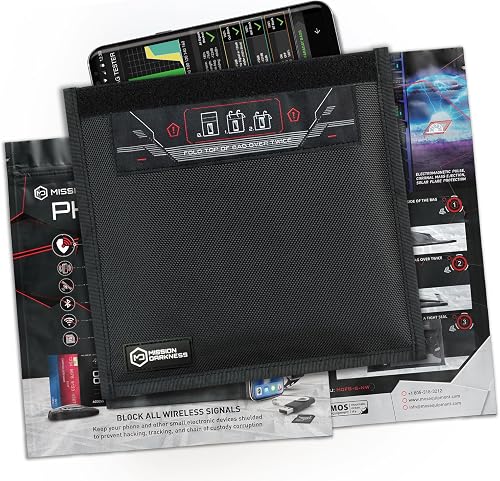
At a glance · Mission Darkness Non-Window Faraday Bag for Phones (MDFB-S-NW)
Best for: Storing one spare phone, handheld radio or small power bank in a sealed, shielded bag as one layer of a grid-down plan
- Shielding claim
- Blocks signals from low MHz to 40 GHz: cellular/5G, Wi-Fi, Bluetooth, GPS, RFID, NFC, radio (manufacturer)
- Standards claimed
- Certified to MIL-STD 188-125 and IEEE 299-2006 (manufacturer)
- Construction
- Two layers of TitanRF Faraday fabric on all interior sides, dual paired seams
- Interior
- 8.5 × 5 in; soft, unstructured walls
- Closure
- Roll down twice, then press the full-width hook-and-loop seal
- Exterior
- Water-resistant ballistic nylon; serial-numbered
Verdict: A well-documented bag for keeping a spare device shielded and dry. Treat the EMP benefit as plausible but unproven, and use it as one layer, not the plan.
In this review
This is a research-based review, based on manufacturer specs and published data. We do not test products. Specs come from Mission Darkness's product page for the Non-Window Faraday Bag for Phones, checked November 1, 2026. EMP guidance comes from the Cybersecurity and Infrastructure Security Agency's EMP Protection and Resilience Guidelines (February 2019), summarized in our EMP guide.
Faraday bags are sold with a lot of fear attached. The useful facts are narrower. A Faraday bag is a shielded enclosure: sealed properly, it blocks radio signals from reaching what is inside. That is measurable, and Mission Darkness publishes the frequency range and standards it claims. Whether a given bag protects a device from a high-altitude nuclear EMP is a different question, and no public test data answers it for consumer bags.
The good news, per CISA, is that small handheld electronics are relatively immune to EMP unless they have long antennas or power cords attached. So the bag's real job in a grid-down kit is modest: keep a spare phone, radio or power bank sealed, unplugged, dry and ready.
Who should buy it
- Households building a small set of spares for a long outage: a spare phone, a handheld GMRS or ham radio, a power bank.
- Anyone who wants a device fully offline: no tracking, no signals, no battery drain from searching for a network.
- People who want a documented product rather than a generic foil pouch: Mission Darkness names its standards and its sealing method.
Who should skip it
- Anyone expecting to protect a power station, solar charge controller or large radio. This bag holds phone-size items; Mission Darkness sells larger bags.
- Buyers who want EMP certainty. There is no independent public EMP data for consumer Faraday bags, and CISA warns many bags sold online are evidence-collection bags that may give only electrostatic protection.
- Households that have not covered water, food, heat and medicine yet. Those come first.
Strengths
- Published standards. Mission Darkness states certification to MIL-STD 188-125 and IEEE 299-2006, and lists the signal types it blocks.
- Two shielding layers. Two layers of TitanRF fabric on all interior sides, with dual paired seams.
- Room for more than a phone. The 8.5 × 5 in interior fits a large phone with about 2 inches to spare, or a phone plus a key fob or small radio.
- Clear sealing instructions. Roll the top down twice and press the full-width seal, with nothing crossing it.
- Durable shell. Water-resistant ballistic nylon protects the fabric and the device.
Drawbacks
- EMP is a claim, not a published result. The product page lists RF shielding standards; it does not publish pulse data for this bag.
- Phone-size only. Good for a spare handset or radio, not for anything bigger.
- Seal discipline matters. Mission Darkness warns that a cable, strap or corner of fabric caught in the closure lets signals through.
- No dB figure on the product page. Shielding depth is described by standards, not by a number you can compare.
- Avoid wet devices and sharp objects, which the maker warns against.
How it compares
CISA's 2019 guidelines list low-cost Level 1 measures for households. Here is how a commercial bag sits next to the two most common do-it-yourself options.
| Spec | Mission Darkness Non-Window bag | Foil wrap, CISA method | Unmodified metal trash can |
|---|---|---|---|
| How it shields | Two layers of TitanRF fabric, rolled seal | Insulating bag, then two or more layers of heavy-duty foil with overlapping seams | Metal body with an unsealed lid |
| What CISA says | Many bags sold online are evidence-grade; check the claims | Listed as a low-cost Level 1 measure | "Do not usually provide reliable EMP protection" unless the gaps are sealed |
| Published standard | MIL-STD 188-125, IEEE 299-2006 (maker) | None | None |
| Reusable | Yes | Re-wrap each time | Yes |
| Fits | Phone-size items | Anything you can wrap | Large items |
Using it in a long outage
What to put in it
- A spare phone, charged to about half and switched off, with offline maps and your contact list saved on it.
- A handheld radio such as the Midland GXT67 PRO or Yaesu FT-65R, with the antenna removed if it fits better.
- A small power bank and a short cable, both unplugged.
- A USB drive with scanned documents: IDs, insurance, prescriptions.
Seal it right
- 01Switch devices off and unplug every cable.
- 02Put the device in a paper or plastic bag first. CISA's foil method starts with an insulating layer, and doing the same here costs nothing.
- 03Roll the top down twice and press the hook-and-loop seal across the full width, with nothing crossing it.
- 04Check it once: put a phone inside, seal the bag and call it. If it rings, reseal and try again.
- 05Store it somewhere dry, and recharge the contents every few months.
Keep perspective
Solar storms and grid attacks cause long outages too, and in those the bag mainly keeps a spare device clean, charged and out of the way. The bigger risks in any long outage are water, heat, food, medicine and carbon monoxide. Build those first with the blackout checklist, then add shielded spares.
Frequently asked questions
- Does the Mission Darkness bag protect against EMP?
- Mission Darkness states certification to MIL-STD 188-125 and IEEE 299-2006 and lists signals from low MHz to 40 GHz. There is no public pulse data for this bag. CISA lists Faraday containers among low-cost measures and also says small handheld electronics are relatively immune to EMP when nothing is plugged in.
- What fits inside?
- The interior is 8.5 × 5 inches, enough for a large phone with about 2 inches to spare, or a phone plus a key fob, cards or a small second device.
- How do I know it is sealed?
- Put a phone inside, roll the top down twice, press the seal and call the phone. Mission Darkness warns that anything caught in the closure lets signals through.
- Is a metal trash can just as good?
- Not reliably. CISA says unmodified metal trash cans do not usually provide reliable EMP protection unless the gaps are sealed.
- Did you test this bag?
- No. This is a research-based review, based on manufacturer specs and published data from CISA. We do not test products.
Sources
- Mission Darkness (MOS Equipment), Non-Window Faraday Bag for Phones: specifications and sealing instructions, checked November 1, 2026.
- CISA / National Coordinating Center for Communications, Electromagnetic Pulse (EMP) Protection and Resilience Guidelines for Critical Infrastructure and Equipment, v2.2, February 5, 2019.
- Federal Register, Executive Order 13865, Coordinating National Resilience to Electromagnetic Pulses, March 29, 2019.
This is a research-based review. PowerLockdown does not test products; specs come from the manufacturer and safety guidance from the public agencies cited. See our editorial policy.
Related guides
Grid-down
EMP and the power grid: the evidence, the dispute and your options
Checklist
Grid-down
Grid-down
Grid-down
Ham and GMRS radio keep a household talking when cell towers go dark
More go-bags and emp storage reviews
Ready America 70280 review: a two-person 72-hour go-bag, and what it leaves out
A two-person evacuation bag to keep by the door or in the car, which you then fill out with water, light and a radio
Ready America 70385 review: one grab-and-go bag for a family of four, with a crank radio and light
A family of four that wants one evacuation bag with food, water, first aid, light and a radio in a single purchase
Red Cross Deluxe 3-Day kit 91052 review: a one-person go-bag strong on hygiene and first aid
One adult who wants a go-bag with hygiene, first aid and light covered, and who will add water and a radio
Two adults who want real meals, a way to heat them outdoors, and a backup for finding water
Uncharted SEVENTY2.0 Pro review: an evacuation pack for two that covers shelter, water and comms
Two or more people who may have to leave home fast and want shelter, water filtration and a radio in one pack