Research-based review · Lights, batteries and power banks
Goal Zero Venture 35 review: a waterproof power bank that refills from a small solar panel when the grid is down
9,600 mAh (35.52 Wh), an IP67 rating, USB-C in and out at 18 W and a built-in flashlight. Goal Zero rates about three phone recharges and a 6 to 12 hour refill from its Nomad 10 panel.
By PowerLockdown EditorialUpdated November 1, 20265 min readBased on manufacturer specs and published dataHow we research
DisclosureAs an Amazon Associate we earn from qualifying purchases. We may earn a commission when you buy through links on this site, at no extra cost to you. Learn more.
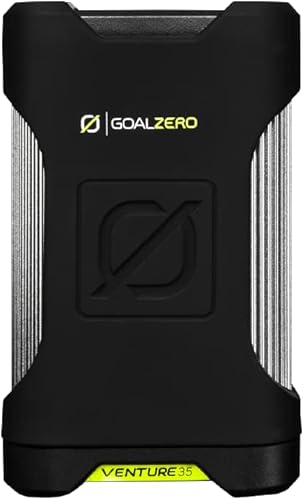
At a glance · Goal Zero Venture 35 Power Bank
Best for: Keeping one person's phone, headlamp and radio charged in a hurricane or flood outage, refilled from a small solar panel
- Capacity
- 9,600 mAh / 35.52 Wh (3.7 V), Li-ion NMC 18650 cells
- Ports
- USB-C PD in/out, 5 to 12 V up to 3 A (18 W max); USB-A out, 5 V up to 3 A (15 W)
- Rated charges
- Smartphone 3, headlamp 7, tablet 1 (manufacturer)
- Recharge time
- USB-C 18 W: 3 h; USB-A 2.4 A: 4 h; Nomad 10 solar: 6 to 12 h; Nomad 20: 4 to 8 h
- Rugged
- IP67: dust tight, submersible to 1 m for 30 min with the port door closed
- Light
- 50-lumen white LED flashlight
- Weight / temp / warranty
- 10.12 oz; operating 32 to 113°F; 2 years
Verdict: One of the few power banks built to survive rain and flood water, and one that pairs naturally with a small solar panel. It is a one-person bank, and it needs recharging every few months in storage.
In this review
This is a research-based review, based on manufacturer specs and published data. We do not test products. Specs and FAQ answers come from Goal Zero's Venture 35 product page, checked November 1, 2026. Planning guidance comes from Ready.gov.
Ready.gov's outage advice includes planning batteries and alternative power sources, such as a portable charger or power bank. Most power banks are made for desks and backpacks. Outages, especially hurricane and flood outages, happen in rain, in cars and in shelters, where water and grit are part of the deal. The Venture 35 is built for that: Goal Zero rates it IP67, dust tight and able to survive submersion to 1 meter for at least 30 minutes with the port door shut.
The capacity is modest. At 35.52 Wh, Goal Zero rates about three smartphone recharges. What makes it useful in a long outage is that it can be refilled from a small solar panel in a day, so it keeps cycling as long as the sun comes out.
Who should buy it
- People in hurricane, flood and wildfire areas who may be charging devices outdoors, in a car or in a shelter.
- Anyone building a go-bag who wants phone power that survives a soaking.
- Households that own, or plan to buy, a small foldable solar panel.
- Owners of USB-C lights and radios such as the Midland ER310PRO.
Who should skip it
- Households that want one bank for everyone. The Anker 737 holds 24,000 mAh and outputs up to 140 W.
- Laptop users. 18 W USB-C is too slow for most laptops.
- Anyone who will not recharge it between outages. Goal Zero's own shelf-life guidance is to charge it every 3 to 6 months.
- People who need AC power. That is a job for a power station such as the EcoFlow RIVER 3 Plus.
Strengths
- IP67. Protected against dust, sand and debris and rated for submersion to 1 m for at least 30 minutes, per Goal Zero.
- Solar-ready. Goal Zero lists charge times from its own panels: 6 to 12 hours with a Nomad 10, 4 to 8 hours with a Nomad 20.
- Two-way USB-C. One port charges the bank and charges your devices, up to 18 W.
- Clear expectations. Goal Zero publishes device estimates: about 3 smartphone recharges, 7 headlamp recharges, 1 tablet recharge.
- Built-in flashlight. A 50-lumen LED, enough for a hallway or tent.
- Light. 10.12 oz.
Drawbacks
- Small for a household. 35.52 Wh is a one-person, few-day bank.
- Needs regular top-ups in storage. Goal Zero says to charge it every 3 to 6 months.
- Narrow operating range. Goal Zero lists 32 to 113°F. A winter outage in an unheated house or car is outside that range.
- Solar panel sold separately. The Nomad charge times assume you own one.
- 18 W limit. Fine for phones, slow for tablets and too slow for most laptops.
How it compares
The Venture 35 against a larger power bank, a small power station and a lantern that doubles as a USB hub. Figures are from each manufacturer's page, checked November 1, 2026.
| Spec | Goal Zero Venture 35 | Anker 737 Power Bank | EcoFlow RIVER 3 Plus | Goal Zero Lighthouse 600 |
|---|---|---|---|---|
| Capacity | 35.52 Wh | 24,000 mAh (Wh not listed) | 286 Wh | 18.98 Wh |
| Max output | 18 W USB-C | 140 W USB | 600 W AC | 7.5 W USB |
| Weather rating | IP67 | Not listed | Not listed | Not listed |
| Solar recharge | Yes, via USB panel | Not directly | Up to 220 W | Yes, Nomad 10 |
| Weight | 10.12 oz | 22.22 oz | 10.4 lb | 1.1 lb |
Using it in a long outage
Budget the 35 Wh
Goal Zero rates about three smartphone recharges per full charge. In a multi-day outage, that is one phone for three days if you top up once a day, or two phones for a day and a half. Put phones in low-power mode, and charge headlamps and radios from it rather than from the phone. Goal Zero rates about seven headlamp recharges, a far better use of the energy than a tablet.
Solar routine
- 01Charge it fully over USB-C before the storm. Goal Zero lists about 3 hours with an 18 W source.
- 02During the outage, set a USB solar panel in full sun and plug the bank into it in the morning.
- 03Charge devices from the bank in the evening, not straight from the panel, so passing clouds do not interrupt them.
- 04Keep the port door closed whenever it is outdoors or in a wet go-bag. The IP67 rating depends on it.
Goal Zero's figure for its Nomad 10 panel is 6 to 12 hours to refill, so one sunny day roughly refills it. In winter or under cloud, expect the long end or worse.
Storage and temperature
Goal Zero lists a 32 to 113°F operating range and a shelf-life note to charge it every 3 to 6 months. Keep it inside the heated part of the house in winter, not in a car or garage, and add a reminder to charge it when you change smoke alarm batteries or check your blackout checklist. For a USB-powered battery charger that runs off a bank like this, see the Panasonic BQ-CC87.
Frequently asked questions
- How many times can the Goal Zero Venture 35 charge a phone?
- Goal Zero rates about 3 smartphone recharges from a full charge. The exact number depends on your phone's battery size.
- Is the Goal Zero Venture 35 waterproof?
- Yes, with the port door closed. Goal Zero rates it IP67: protected against dust and able to withstand submersion to 1 meter for at least 30 minutes.
- How long does the Venture 35 take to charge from solar?
- Goal Zero lists 6 to 12 hours with a Nomad 10 panel and 4 to 8 hours with a Nomad 20. A USB-C 18 W source takes about 3 hours.
- Can the Venture 35 charge a laptop?
- Its USB-C port tops out at 18 W, which is too slow for most laptops. Use a higher-output bank or a power station for laptops.
- Did you test the Goal Zero Venture 35?
- No. This is a research-based review, based on manufacturer specs and published data from Goal Zero, Ready.gov and the CDC. We do not test products.
Sources
- Goal Zero, Venture 35 Power Bank: specs, charge times and FAQ, checked November 1, 2026.
- Ready.gov (FEMA), Power Outages, updated June 4, 2026.
- CDC, About Carbon Monoxide Poisoning, reviewed October 2026.
This is a research-based review. PowerLockdown does not test products; specs come from the manufacturer and safety guidance from the public agencies cited. See our editorial policy.
Related guides
More lights, batteries and power banks reviews
Anker 737 Power Bank review: keeping phones and a laptop charged through an outage
Keeping two or three phones, a GMRS radio or a laptop charged for the first days of an outage, and refilling from a power station or car
Black Diamond Spot 400 review: hands-free light that runs on AAA batteries in an outage
Hands-free light for cooking, checking the breaker panel, caring for kids and moving around a dark house
Energizer 38511 review: a night light that switches on by itself the moment the power fails
Hallways, stairs and bedrooms: light that is already on when a night outage starts, so nobody walks into the dark
An evening lantern for a long outage that tops itself up on a windowsill during the day, with AA cells as backup
Households that want rechargeable AAs they can buy at any store, cycled through lights and radios during an outage
Go-bags, car kits and the backup-battery bag for flashlights and radios that may sit untouched for years
Energizer WeatheReady lantern review: 500 lumens of room light that runs for days on three D cells
The main room light for a household that stores disposable batteries, through an outage measured in days
Eton Blackout Buddy Swivel review: a slim wall light that comes on by itself when the power goes out
Bedrooms, hallways and offices: an automatic light at the moment the power fails, then a pocket flashlight
The kitchen or living room fixture you most want lit when the power fails at dinnertime
Fenix PD36R PRO review: a long-throw rechargeable flashlight for checking the yard and storm damage
Checking the yard, the roofline, a generator or downed branches after a storm, and finding the breaker panel fast
Goal Zero Lighthouse 600 review: a rechargeable room lantern with a crank for power outages
Lighting a kitchen or living room for the whole household every evening of a multi-day outage, without candles or fuel
Lepro 1500lm lantern review: the brightest room light on our list that runs on three D cells
Lighting a kitchen or living room bright enough to cook, read and work, during an outage of a few days
Keeping AA lights and radios running from a power bank or power station when you do not want a separate charger
Panasonic BQ-CC87 review: the USB charger that turns a power bank into AA batteries during an outage
Recharging NiMH AA and AAA cells from a power bank, power station or car USB port when the grid is down
Panasonic eneloop AA review: rechargeable batteries that hold a charge until the power goes out
Replacing the drawer of disposable AAs for radios, lanterns and remotes, recharged from a power station, power bank or solar during a long outage
High-drain outage gear used every night: headlamps, bright flashlights and lanterns run on high