Form PL-2 · Blackout power planner
Pick what must stay on. See how long each battery runs it.
Tick your appliances and the planner works out the hours you get from 11 portable power stations, and which of 7 generators can carry the load. Every figure is math on manufacturer specs. We do not test products.
Updated November 16, 2026 · Runs in your browser · nothing saved
The formula
battery Wh × 0.85
÷ your average watts
= hours of runtime
Then one check: can the unit handle everything on at once, plus the biggest motor starting. Method and sources.
1. Your list
Typical watts shown. Type over them with the numbers on your own labels.
Start from a common list
Have the yellow EnergyGuide label for your fridge or freezer? Multiply its yearly kWh by 0.34 and enter that as the running watts. A 400 kWh model comes to about 137 W.
2.4 kWh/day · 310 W running · 1,310 W peak
Runtimes2. Hours on a power station
From a full charge · no recharging · smallest battery first
The smallest station on our list that runs this for 1 day is the Anker SOLIX F3800 Plus, at about 32 h per charge.
DisclosureAs an Amazon Associate we earn from qualifying purchases. We may earn a commission when you buy through links on this site, at no extra cost to you. Learn more.
Going past one charge
To put back what this list uses each day you would need about 1,000 W of solar panels, assuming 4 hours of full sun and panels delivering 75% of their rating. Winter and cloud cut that hard. See the 30-day plan.
EcoFlow RIVER 3 Plus
286 Wh · 600 W · 1,200 W surge · 10.4 lb
Will not run it
Refrigerator (full-size) starting takes the list to 1,310 W. Surge rating is 1,200 W.
Jackery Explorer 300 v2
288 Wh · 300 W · 600 W surge · 8.16 lb
Will not run it
Your list draws 310 W at once. This unit is rated 300 W.
EcoFlow DELTA 3 Plus
1,024 Wh · 1,800 W · 3,600 W surge · 27.6 lb
8.6 h
one full charge
Anker SOLIX C1000
1,056 Wh · 1,800 W · 2,400 W surge · 28.44 lb
8.9 h
one full charge
Jackery Explorer 1000 v2
1,070 Wh · 1,500 W · 3,000 W surge · 23.8 lb
9 h
one full charge
BLUETTI AC180
1,152 Wh · 1,800 W · 2,700 W surge · 35.27 lb
9.7 h
one full charge
Jackery Explorer 2000 v2
2,042 Wh · 2,200 W · 4,400 W surge · 39.5 lb
17 h
one full charge
EcoFlow DELTA 2 Max
2,048 Wh · 2,400 W · 4,800 W surge · 50 lb
17 h
one full charge
Smallest that covers 1 day
Anker SOLIX F3800 Plus
3,840 Wh · 6,000 W · 136.7 lb
32 h
one full charge
EcoFlow DELTA Pro 3
4,096 Wh · 4,000 W · 8,000 W surge · 113.54 lb
34 h
one full charge
Jackery Explorer 5000 Plus
5,040 Wh · 7,200 W · 14,400 W surge · 134.5 lb
42 h
one full charge


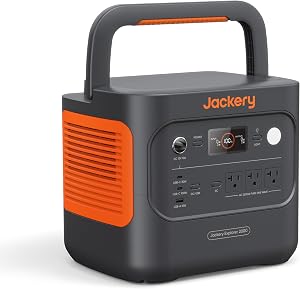


Estimates from rated capacity, not measured runtimes. Bars use a square-root scale. Cold, battery age and high loads shorten real runtime.
3. Generators that carry it
Sized with 20% headroom · dual-fuel checked on propane, the weaker fuel
Your list needs about 372 running watts and 1,310 starting watts. The smallest generator here that covers both is the Honda EU2200i.
Honda EU2200i
Gasoline · inverter
1,800 / 2,200 W gas
3.2 h at rated load / 8.1 h at 25% load on 0.95 gal
Smallest that fitsCovers the list.
Champion 3500W Dual Fuel (201296)
Gasoline + Propane
3,500 / 4,375 W gas3,150 / 3,950 W propane
Up to 14 h on gasoline / 10.5 h on a 20 lb propane tank at 50% load
FitsCovers the list on either fuel.
Champion 4500W Dual Fuel Inverter (201321)
Gasoline + Propane · inverter
3,650 / 4,500 W gas3,285 / 4,500 W propane
Up to 22 h on gasoline / 21 h on a 20 lb propane tank at 25% load
FitsCovers the list on either fuel.
Generac GP7500E Dual Fuel
Gasoline + Propane
7,500 / 9,400 W gas6,800 / 8,500 W propane
Up to 10 h on gasoline / 5 h on a 20 lb propane tank at 50% load
FitsCovers the list on either fuel.
Westinghouse WGen9500DFc
Gasoline + Propane
9,500 / 12,500 W gas8,500 / 11,200 W propane
Up to 12 h at 25% load on 6.6 gal gasoline / about 7 h on propane at 50% load (tank size not stated)
FitsCovers the list on either fuel.
Champion 9500W Dual Fuel (201508)
Gasoline + Propane
9,500 / 12,000 W gas8,550 / 10,800 W propane
Up to 8 h on gasoline at 50% load (7.7 gal); about 4.5 h on a 20 lb propane tank at 50% load
FitsCovers the list on either fuel.
DuroMax XP13000HX
Gasoline + Propane
10,500 / 13,000 W gas10,000 / 12,500 W propane
17 h at 25% load / 8.5 h at 50% load on gasoline; 13 h / 6.5 h on propane (DuroMax suggests a 40 lb tank minimum)
FitsCovers the list on either fuel.
Carbon monoxide. A generator runs outdoors only, at least 20 feet from doors and windows, with the exhaust pointed away. Put a battery CO alarm near bedrooms. CDC
Save or share
Keep this list
The link holds your appliance list and numbers, nothing else. Open it later, or send it to whoever is buying the gear.
Next
Power is one system
- Readiness score: how many days your water, food, heat and medicine last.
- Best power station for a refrigerator
- Best generator for a power outage
- All gear reviews
How the math works
- Energy per day. Running watts × how many × hours a day. Refrigerators and freezers cycle on and off, so their hours are divided by three, the method in the U.S. Department of Energy's appliance guide.
- Runtime. The battery's rated watt-hours × 0.85, divided by your average draw (daily Wh ÷ 24). The 0.85 is our allowance for inverter losses. It is a planning figure, not a manufacturer one.
- Can it power the list. Your running watts must fit under the unit's continuous AC rating. Running watts plus the single largest motor start must fit under its surge rating. Where a maker publishes no surge figure, we hold the unit to its continuous rating.
- Generators. Running watts × 1.2 must fit under the generator's running watts, and the starting load under its starting watts. Dual-fuel models are checked on propane, where they make less power.
- Solar. Daily Wh ÷ 0.85 ÷ (4 sun hours × 0.75), rounded up to the next 50 W.
Battery and generator specs come from each manufacturer's product page and are dated on the product's review. Appliance wattages are typical published figures, checked October 27, 2026, not measurements of your appliances. Nothing here was tested by us.
Questions
- How long will a power station run a refrigerator?
- Divide the battery's usable energy by what the refrigerator uses in a day. With a typical full-size fridge at about 1.6 kWh a day and 85% of the battery reaching the appliance, a 1,000 Wh station runs it for roughly 13 hours and a 2,000 Wh station for about 26 hours. A newer ENERGY STAR fridge near 1.0 kWh a day stretches a 1,000 Wh station to about 20 hours.
- What is the difference between running watts and starting watts?
- Running watts are what a device draws once it is on. Motors and compressors, such as a refrigerator, a sump pump or a furnace blower, draw several times that for a moment when they start. A power station needs enough surge rating, and a generator enough starting watts, to cover that moment.
- Why does the planner use 85% of the battery's rated capacity?
- A power station stores DC and converts it to AC for household plugs, and the conversion loses energy. 85% is our planning assumption, not a manufacturer figure. Real results vary with the load, temperature and the age of the battery.
- Can a portable power station run a space heater?
- Most mid-size and larger units can power a 1,500 W heater, but only briefly: a 1,000 Wh station lasts well under an hour at that draw. Electric heat is usually a generator job. In a winter outage a rated indoor fuel heater with a battery CO alarm covers more hours.
- Did you test these power stations and generators?
- No. The planner is arithmetic on manufacturer specs and published typical appliance wattages. We do not test products. Check the label on your own appliances and enter those numbers for a closer estimate.
The Grid Report
An occasional email when NERC publishes a new reliability assessment, before hurricane and winter seasons, and when we add new plans and guides. No spam; unsubscribe anytime. See our privacy policy.