Research-based review · Portable power stations
Jackery Explorer 2000 v2 review: two days of fridge power in a 40 lb box
A 2 kWh LiFePO4 station with 2,200 W of output and a sub-20 ms UPS. Enough for the refrigerator plus the basics through a two-day outage, without a generator.
By PowerLockdown EditorialUpdated November 1, 20266 min readBased on manufacturer specs and published dataHow we research
DisclosureAs an Amazon Associate we earn from qualifying purchases. We may earn a commission when you buy through links on this site, at no extra cost to you. Learn more.
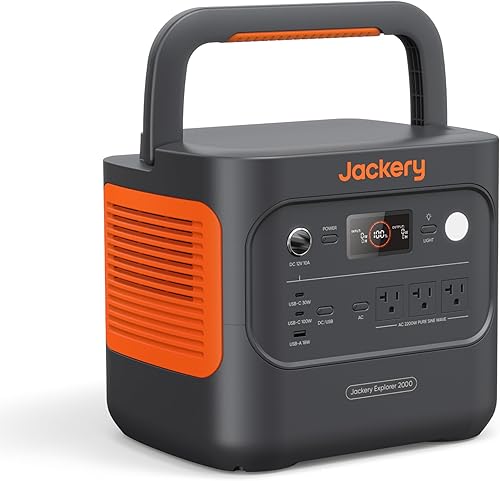
At a glance · Jackery Explorer 2000 v2
Best for: Running a refrigerator, lights, a router and phones through a two-day outage from one battery, refilled by solar after that
- Capacity
- 2,042 Wh (45.6 Ah / 44.8 V)
- AC output
- 2,200 W rated, 4,400 W surge peak; 3 outlets, 120 V
- Battery
- LiFePO4, 4,000 cycles to 70%+ capacity
- Recharge
- Wall 1.75 h (1.7 h headline); solar up to 400 W via two 8 mm DC inputs; car 24 h
- Other outputs
- USB-C 100 W + 30 W, USB-A 18 W, 12 V car port
- UPS switchover
- Under 20 ms
- Weight
- About 39.5 lb (17.9 kg)
- Warranty
- 3+2 years when bought on jackery.com (manufacturer)
Verdict: Twice the energy of a 1 kWh unit for about 16 lb more. The 400 W solar ceiling and lack of expansion limit it in outages longer than a few days.
In this review
This is a research-based review, based on manufacturer specs and published data. We do not test products. Figures come from Jackery's Explorer 2000 v2 product page and FAQ, checked November 1, 2026, and from the federal sources cited below.
The Explorer 2000 v2 is Jackery's answer to a common outage problem: one kilowatt-hour runs a refrigerator for about a day, but storms often leave homes dark for two or three. Doubling capacity in a single box avoids juggling two batteries. Jackery says it is 40% smaller and 34% lighter than the previous generation, and at about 39.5 lb one adult can still move it.
Jackery's FAQ is direct about two limits. The 2000 v2 is not expandable, and Jackery does not recommend any of its power stations for medical devices or life-support equipment. Both shape who should buy it.
Who should buy it
- Households whose typical outage lasts one to three days and whose priority is food: fridge, freezer cycling, lights and the internet router.
- People who want 2 kWh without stepping up to a 100 lb wheeled whole-home unit.
- Homes that want a UPS for a desktop computer or network gear: Jackery lists under 20 ms switching.
- Buyers who already own one or two 200 W panels. The two DC inputs combine up to 400 W.
Who should skip it
- Anyone planning a long grid-down stretch on solar alone. 400 W of input is low for a 2 kWh battery. The EcoFlow DELTA 3 Plus accepts 1,000 W and can expand to 5 kWh.
- Households that may want more capacity later. Jackery's FAQ says the 2000 v2 is not expandable and points to its Plus series instead.
- Users of CPAP, oxygen or other medical devices. Jackery says its power stations are not recommended for medical or life-support equipment.
- Homes needing 240 V. Look at the EcoFlow DELTA Pro 3 or Anker SOLIX F3800 Plus.
Strengths
- 2 kWh in one unit. 2,042 Wh carries a typical refrigerator for close to two days by our math, with no extra batteries or cables.
- High output. 2,200 W continuous with a 4,400 W surge peak covers a fridge, a microwave used briefly, or a coffee maker, one at a time.
- Light for its size. About 39.5 lb. Jackery says one person can move it.
- Long-life chemistry. LiFePO4 rated for 4,000 cycles to 70%+ capacity.
- Fast wall recharge. 1.75 hours on AC per the spec table (1.7 hours in Jackery's headline), so a few hours of restored power or a short generator run refills it.
- Quiet. Jackery rates it under 30 dB, which matters if it sits in a bedroom overnight.
Drawbacks
- Only three AC outlets. You will need a heavy-duty power strip for more than three devices. Keep the total under 2,200 W.
- 400 W solar ceiling. On a clear day that is roughly 1.5 to 2 kWh at best, often less. In winter, solar may not refill it in a day.
- Not expandable. Jackery's FAQ confirms this.
- Slow car charging. Jackery lists 24 hours from a 12 V car adapter, so the car is a trickle, not a strategy.
- Medical-use exclusion. Jackery's FAQ advises against medical devices and life-support equipment, and warns people with implanted pacemakers not to use the product.
- Stock. Jackery's own store showed the unit sold out when we checked on November 1, 2026. Amazon availability may differ.
How it compares
Alternatives at 1 to 2 kWh, plus the step up to whole-home capacity. Figures are from each maker's page.
| Spec | Jackery Explorer 2000 v2 | Jackery Explorer 1000 v2 | EcoFlow DELTA 3 Plus | EcoFlow DELTA Pro 3 |
|---|---|---|---|---|
| Capacity | 2,042 Wh | 1,070 Wh | 1,024 Wh (5 kWh max) | 4,096 Wh (12 kWh max) |
| AC continuous / surge | 2,200 / 4,400 W | 1,500 / 3,000 W | 1,800 / 3,600 W | 4,000 / 8,000 W |
| 240 V output | No | No | No | Yes |
| Max solar input | 400 W | 400 W | 1,000 W | 2,600 W |
| Weight | 39.5 lb | 23.8 lb | 27.6 lb | 113.54 lb |
Using it in a long outage
How long it runs your refrigerator
Take the yearly kWh on your fridge's yellow EnergyGuide label and divide by 365. A fridge rated at 400 kWh a year averages about 1,100 Wh a day. Assume roughly 85% of the battery reaches the appliance after inverter losses (our planning assumption, not a Jackery figure): 2,042 Wh × 0.85 is about 1,735 Wh, or roughly 38 hours for that fridge alone. Add a router at 10 W and a few LED lamps, and plan on about a day and a half.
You can stretch that by cycling. The FDA says a closed refrigerator keeps food safe for about 4 hours, and a full freezer for about 48 hours. Run the fridge for an hour or two, unplug it for a few hours with the door shut, and check it with a thermometer. Jackery also lists an Energy Saving Mode, turned on by holding the AC and main power buttons together.
Solar for day three and beyond
Two 200 W panels are the most this unit can use. Jackery notes that a panel's rated output is a laboratory figure and real output depends on light intensity and panel angle. On a good day, assume enough to replace most of a day's fridge use; on a cloudy or winter day, much less. Put the panels in full sun, angle them toward it, and move them through the day.
- 01Charge to 100% when a storm is forecast, and top up monthly between outages.
- 02Keep the unit indoors. Jackery lists charging only between 32°F and 113°F.
- 03Run the fridge during the day while solar comes in; save the battery for the router, lights and phones overnight.
- 04Charge phones and laptops from the USB-C ports to avoid inverter losses.
Jackery sells this unit as the Solar Generator 2000 v2 with two SolarSaga 200W panels. For the smaller version of the same idea, see our Jackery Solar Generator 1000 v2 review.
Frequently asked questions
- How long will the Jackery Explorer 2000 v2 run a refrigerator?
- It depends on the fridge. One rated at 400 kWh a year uses about 1,100 Wh a day, so a full charge runs it for roughly 38 hours by our math. Cycling the fridge off for a few hours at a time stretches that.
- Is the Explorer 2000 v2 expandable?
- No. Jackery's FAQ says it is not expandable and suggests its Plus series for expandable capacity.
- Can I use the Explorer 2000 v2 for a CPAP?
- Jackery says its power stations are not recommended for medical devices or life-support equipment. Ask your equipment supplier which backup it supports.
- Did you test the Explorer 2000 v2?
- No. This is a research-based review, based on manufacturer specs and published data from the FDA and Ready.gov. We do not test products.
Sources
- Jackery, Explorer 2000 v2 Portable Power Station: tech specs and FAQ, checked November 1, 2026.
- U.S. Food and Drug Administration, Food and Water Safety During Power Outages and Floods, current as of March 5, 2024.
- Ready.gov (FEMA), Power Outages, updated June 4, 2026.
This is a research-based review. PowerLockdown does not test products; specs come from the manufacturer and safety guidance from the public agencies cited. See our editorial policy.
Related guides
On BackupPowerAI
On BackupPowerAI
What size power station you need: the sizing math, worked through
On BackupPowerAI
On BackupPowerAI
Seasonal prep
More portable power stations reviews
Anker SOLIX C1000 review: a 1 kWh station for the fridge with room to grow
Running a refrigerator, lights, phones and a router through a one- or two-day outage, with the option to double capacity later
Anker SOLIX F3800 Plus review: 6,000 W of 240 V backup for long outages
Backing up essential 120 and 240 V home circuits through outages of several days, with large solar arrays or a 240 V generator for recharge
BLUETTI AC180 review: a 1 kWh battery for the fridge, lights and phones through a one-day outage
Running a refrigerator, LED lights, a router and phone charging through an outage of about a day, with solar or a car to stretch it
EcoFlow DELTA 2 Max review: 2 kWh for a fridge, freezer and sump pump in a multi-day outage
Keeping a refrigerator, a chest freezer, lights and a router going for two to three days, with solar to stretch it further
EcoFlow DELTA 3 Plus review: a 1 kWh fridge battery that scales to 5 kWh
A refrigerator-capable battery that refills quickly from solar, with a path to multi-day capacity
EcoFlow DELTA Pro 3 review: 120/240 V battery backup for essential home circuits
Backing up essential home circuits (fridge, well pump, furnace blower, lights) through a multi-day outage, recharged by solar or a generator
EcoFlow RIVER 3 Plus review: a small battery for the router, phones and lights
Keeping the internet router, phones, a laptop and LED lights running through outages of a few hours to a night
Jackery Explorer 1000 v2 review: a 1 kWh battery for the fridge, phones and lights
Keeping a refrigerator, phones, lights and a router going through a one- to two-day outage, refilled by solar after that
Jackery Explorer 300 v2 review: a small bedside UPS for a router, phones or a CPAP
Keeping a modem and router, phones, a lamp or a CPAP running through a short outage or one night, as a plug-in UPS that switches over on its own
Jackery Explorer 5000 Plus review: 7,200 W of 120/240 V backup for multi-day outages
Running 120 and 240 V household essentials, including a well pump or central air in short windows, through outages that last several days