Guides · Gear picks
Best power station for refrigerator backup
A fridge is the appliance most households want to save first. Size the station for the compressor's startup surge and a day of cycling, and it is one of the easier loads to back up.

Photo: Fabian Kleiser / Unsplash
By PowerLockdown EditorialUpdated November 1, 20269 min readHow we research
In this guide
DisclosureAs an Amazon Associate we earn from qualifying purchases. We may earn a commission when you buy through links on this site, at no extra cost to you. Learn more.
The short answer
For most full-size refrigerators, a LiFePO4 power station with about 1,000 Wh of capacity and at least 1,500 W of continuous output is the practical minimum. That covers the compressor's startup surge and runs a typical fridge for most of a day. For a fridge plus a freezer, or two days between recharges, step up to about 2,000 Wh.
At a glance
| Model | Capacity | Best for | Fridge-only runtime (estimate) |
|---|---|---|---|
| Anker SOLIX C1000 | 1,056 Wh | Most kitchens, with room to expand | About 13 to 21 hours |
| EcoFlow DELTA 3 Plus | 1,024 Wh | Fast UPS switchover and big solar input | About 13 to 21 hours |
| Jackery Explorer 2000 v2 | 2,042 Wh | A full day or more without recharging | About 26 to 42 hours |
| Jackery Explorer 1000 v2 | 1,070 Wh | Lightest 1 kWh unit on this list | About 14 to 22 hours |
| BLUETTI AC180 | 1,152 Wh | Most capacity in the 1 kWh class | About 15 to 23 hours |
| EcoFlow DELTA 2 Max | 2,048 Wh | Fridge plus a chest freezer | About 26 to 42 hours |
The picks
- 01Best overallAnker SOLIX C1000

A typical fridge plus phones and lights for a one-day outage
- Capacity
- 1,056 Wh
- Cont./surge
- 1,800 / 2,400 W
- Chem./fuel
- LiFePO4
- Weight
- 28.44 lb
- 02Best for solar rechargingEcoFlow DELTA 3 Plus

Owners who want to recharge the fridge battery from panels each day
- Capacity
- 1,024 Wh
- Cont./surge
- 1,800 / 3,600 W
- Chem./fuel
- LiFePO4 (LFP)
- Weight
- 27.6 lb
- 03Best for a full dayJackery Explorer 2000 v2
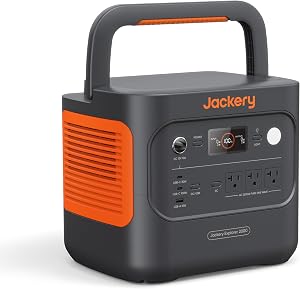
Running a fridge through a day and night without recharging
- Capacity
- 2,042 Wh
- Cont./surge
- 2,200 / 4,400 W
- Chem./fuel
- LiFePO4
- Weight
- 39.5 lb
- 04Lightest 1 kWhJackery Explorer 1000 v2

Carrying the fridge battery up and down stairs or out to the car
- Capacity
- 1,070 Wh
- Cont./surge
- 1,500 / 3,000 W
- Chem./fuel
- LiFePO4
- Weight
- 23.8 lb
- 05Most capacity, 1 kWh classBLUETTI AC180

Getting a few extra fridge hours from a mid-size unit
- Capacity
- 1,152 Wh
- Cont./surge
- 1,800 / 2,700 W
- Chem./fuel
- LiFePO4
- Weight
- 35.27 lb
- 06Best for fridge plus freezerEcoFlow DELTA 2 Max

A kitchen fridge plus a chest or upright freezer
- Capacity
- 2,048 Wh
- Cont./surge
- 2,400 / 4,800 W
- Chem./fuel
- LiFePO4 (LFP)
- Weight
- 50 lb
No. 1Best overall
Anker SOLIX C1000
Best for: A typical fridge plus phones and lights for a one-day outage
1,800 W continuous and 2,400 W surge clear any household fridge's startup, and the 1,056 Wh LiFePO4 pack expands to 2,112 Wh with Anker's matching battery. Six AC outlets and up to 600 W of solar input make it a sensible center for a small outage setup.
Strengths
- Expandable to 2,112 Wh
- Under 20 ms UPS switchover per Anker
- 3,000 cycles to 80%+
Tradeoffs
- About 28 lb
- A newer C1000 Gen 2 has different specs, so match the listing to the model
- Note: A newer C1000 Gen 2 has different specs. Make sure the listing matches the model you want.
| Capacity | 1,056 Wh |
| AC output | 1,800 W continuous / 2,400 W surge |
| Battery | LiFePO4 |
| Weight | 28.44 lb |
| Max solar input | 600 W |
| Rated cycles | 3,000 cycles to 80%+ |
| AC outlets | 6 |
| Expansion | Up to 2,112 Wh with the matching expansion battery |
No. 2Best for solar recharging
EcoFlow DELTA 3 Plus
Best for: Owners who want to recharge the fridge battery from panels each day
Up to 1,000 W of solar input is the highest in the 1 kWh class here, so a sunny afternoon can refill most of the pack. EcoFlow lists a sub-10 ms UPS switchover and 3,600 W surge. It expands to 5 kWh with extra batteries.
Strengths
- Fast UPS switchover
- Expands to 5 kWh
- 4,000 cycles to 80%+
Tradeoffs
- Panels and extra batteries add cost and weight
- 1,024 Wh base capacity is the smallest here
| Capacity | 1,024 Wh |
| AC output | 1,800 W continuous / 3,600 W surge |
| Battery | LiFePO4 (LFP) |
| Weight | 27.6 lb |
| Max solar input | 1,000 W |
| Rated cycles | 4,000 cycles to 80%+ |
| AC outlets | 6 |
| UPS switchover | <10 ms |
| Expansion | Up to 5 kWh with compatible EcoFlow extra batteries |
No. 3Best for a full day
Jackery Explorer 2000 v2
Best for: Running a fridge through a day and night without recharging
At 2,042 Wh, the Explorer 2000 v2 carries a typical fridge for roughly 26 to 42 hours on our math, and its 4,400 W surge rating can handle a fridge and freezer compressor starting together. It weighs 39.5 lb, light for a 2 kWh unit.
Strengths
- 2 kWh in under 40 lb
- 4,400 W surge
- Under 20 ms UPS per Jackery
Tradeoffs
- Jackery states it is not expandable
- 400 W max solar input is slow for this capacity
- Note: Jackery states the 2000 v2 is not expandable.
| Capacity | 2,042 Wh |
| AC output | 2,200 W continuous / 4,400 W surge |
| Battery | LiFePO4 |
| Weight | 39.5 lb |
| Max solar input | 400 W |
| Rated cycles | 4,000 cycles to 70%+ |
| AC outlets | 3 |
| UPS switchover | <20 ms |
No. 4Lightest 1 kWh
Jackery Explorer 1000 v2
Best for: Carrying the fridge battery up and down stairs or out to the car
At 23.8 lb it is the lightest unit near 1 kWh on this list, with 1,500 W continuous and 3,000 W surge. That is enough for a single fridge, though not for a fridge and a microwave at the same time.
Strengths
- 23.8 lb
- 3,000 W surge
- 4,000 cycles to 70%+
Tradeoffs
- Three AC outlets
- Jackery's FAQ says it does not recommend the unit for medical or life-support devices
- Note: Jackery's own FAQ says it does not recommend the unit for medical or life-support devices.
| Capacity | 1,070 Wh |
| AC output | 1,500 W continuous / 3,000 W surge |
| Battery | LiFePO4 |
| Weight | 23.8 lb |
| Max solar input | 400 W |
| Rated cycles | 4,000 cycles to 70%+ |
| AC outlets | 3 |
No. 5Most capacity, 1 kWh class
BLUETTI AC180
Best for: Getting a few extra fridge hours from a mid-size unit
1,152 Wh is the largest pack in the 1 kWh group here, with 1,800 W continuous and 2,700 W surge. Four AC outlets and 500 W of solar input round it out.
Strengths
- 1,152 Wh
- 1,800 W continuous
- 3,500+ cycles to 80%
Tradeoffs
- 35.27 lb, heavy for its class
- Not expandable
- BLUETTI's own store showed it out of stock when we checked
- Note: 2,700 W is BLUETTI's Power Lifting Mode for resistive heating loads. BLUETTI lists pass-through charging but no UPS switchover time.
| Capacity | 1,152 Wh |
| AC output | 1,800 W continuous / 2,700 W surge |
| Battery | LiFePO4 |
| Weight | 35.27 lb |
| Max solar input | 500 W |
| Rated cycles | 3,500+ cycles to 80% |
| AC outlets | 4 |
No. 6Best for fridge plus freezer
EcoFlow DELTA 2 Max
Best for: A kitchen fridge plus a chest or upright freezer
2,048 Wh with 2,400 W continuous and 4,800 W surge gives the most headroom for two compressors. It expands to 6 kWh with two extra batteries and takes up to 1,000 W of solar.
Strengths
- 4,800 W surge
- Expands to 6 kWh
- 1,000 W solar input
Tradeoffs
- 50 lb
- Overkill for a single small fridge
- Note: Solar input 11 to 60 V, 500 W per port, 1,000 W across two ports. AC charging 1,800 W. X-Boost runs resistive loads up to 3,400 W. EcoFlow's page lists no UPS switchover time.
| Capacity | 2,048 Wh |
| AC output | 2,400 W continuous / 4,800 W surge |
| Battery | LiFePO4 (LFP) |
| Weight | 50 lb |
| Max solar input | 1,000 W |
| Rated cycles | 3,000 cycles to 80%+ |
| AC outlets | 6 |
| Expansion | Up to 6 kWh with two extra batteries |
Full write-ups for the top three: Anker SOLIX C1000 review, EcoFlow DELTA 3 Plus review and Jackery Explorer 2000 v2 review.
Fridge sizing math: watts, surge and daily Wh
Three numbers decide whether a power station can run your refrigerator. Get them from the fridge's nameplate or EnergyGuide label where you can, and use the published ranges below where you cannot.
- 01Running watts. Champion Power Equipment's wattage chart lists a refrigerator at 150 to 400 W while running, and a freezer at 100 to 500 W. The station's continuous rating must exceed this, plus anything else plugged in.
- 02Startup surge. The same chart lists 800 to 1,200 W of starting watts for a fridge and 500 to 1,000 W for a freezer. The compressor pulls this for a moment each time it kicks on. The station's surge rating must cover it, or the station will trip.
- 03Daily energy (Wh). A fridge does not run its compressor nonstop. Virginia Cooperative Extension's guide to estimating appliance use says to divide the hours a fridge is plugged in by three, because it cycles on and off to hold temperature. That is the duty cycle: roughly one-third.
Worked example
A fridge drawing 200 W while running: 200 W × 24 hours ÷ 3 = 1,600 Wh a day. Newer fridges use less. The Department of Energy's federal buying guidance gives an ENERGY STAR 18.1 cubic foot top-freezer model at 363.5 kWh a year, which works out to about 1,000 Wh a day (363,500 ÷ 365). If your fridge has an EnergyGuide label, divide its kWh-per-year figure by 365 for your own daily number. ENERGY STAR says an older fridge uses about 20% more energy than a certified model, so an old unit in a garage can land well above these figures.
Next, convert the station's rated capacity to usable energy. Inverter and conversion losses mean you will not get every rated watt-hour out as AC. We plan with 85% usable, a conservative working assumption rather than a manufacturer figure. A 1,056 Wh station gives about 898 usable Wh. Divide by the fridge's hourly draw (daily Wh ÷ 24) for runtime: 898 ÷ 41.7 ≈ 21.5 hours for a 1,000 Wh-a-day fridge, or 898 ÷ 66.7 ≈ 13.5 hours at 1,600 Wh a day.
| Station | Usable Wh (85%) | Hours at 1.0 kWh/day | Hours at 1.6 kWh/day |
|---|---|---|---|
| Jackery Explorer 1000 v2 | 910 | 21.8 | 13.6 |
| Anker SOLIX C1000 | 898 | 21.5 | 13.5 |
| EcoFlow DELTA 3 Plus | 870 | 20.9 | 13.1 |
| BLUETTI AC180 | 979 | 23.5 | 14.7 |
| Jackery Explorer 2000 v2 | 1,736 | 41.7 | 26.0 |
| EcoFlow DELTA 2 Max | 1,741 | 41.8 | 26.1 |
Portable power station for a freezer, or fridge plus freezer
A chest freezer at 150 W running, cycling one-third of the time, uses about 1,200 Wh a day. Add that to a 1,600 Wh fridge and you need about 2,800 Wh a day, so even a 2 kWh station covers roughly 15 hours. If both compressors start at once, the surge can reach about 2,200 W on Champion's upper figures. That is why the two 2 kWh picks, with 4,400 W and 4,800 W surge ratings, suit a two-appliance setup.
Stretch the battery: run the fridge in shifts
You do not have to power the fridge around the clock. The CDC says food stays safe for up to 4 hours in a closed refrigerator, 48 hours in a full freezer and 24 hours in a half-full one, and the fridge should be at 40°F or below. That window lets a smaller station keep food cold in blocks.
- Turn the fridge and freezer to their coldest settings a day before a forecast storm.
- Keep doors shut. Ready.gov says a closed fridge keeps food cold for about four hours.
- Put an appliance thermometer inside so you know the actual temperature, not a guess.
- Run the fridge on the station for a few hours, then unplug it and recharge the station from solar or a generator outdoors.
- Fill empty freezer space with frozen water bottles. A full freezer holds temperature about twice as long as a half-full one, per the CDC.
Our food safety guide covers what to keep and what to throw out after an outage. BackupPowerAI's how to power a refrigerator during an outage walks through the setup in more detail.
What to look for in a battery backup for a refrigerator
Surge rating first
A station that cannot start the compressor is useless for a fridge, however large its battery. Look for a surge rating of at least 1,500 W for one fridge and 2,500 W or more for a fridge and freezer. Every pick here clears those numbers.
LiFePO4 chemistry
All six picks use lithium iron phosphate (LiFePO4) cells, which their makers rate for 3,000 to 4,000 cycles. That matters if you plan to cycle the battery daily through a long outage.
UPS switchover
A fast UPS mode lets the fridge stay plugged into the station while the station stays plugged into the wall. When the grid drops, the station takes over. EcoFlow lists under 10 ms for the DELTA 3 Plus; Anker and Jackery list under 20 ms for the C1000 and 2000 v2. A fridge does not need a perfect switchover, but it means you do not have to be home to move the plug.
A way to recharge
A battery alone buys hours. Solar input or a generator turns it into days. Compare maximum solar input: 1,000 W on the DELTA 3 Plus and DELTA 2 Max, 600 W on the C1000, 500 W on the AC180 and 400 W on both Jackerys.
Safety
Frequently asked questions
- What size power station do I need for a refrigerator?
- For one full-size fridge, about 1,000 Wh with at least 1,500 W continuous output and a surge rating above the fridge's 800 to 1,200 W startup draw. That runs a typical fridge for roughly 13 to 22 hours. For a fridge and a freezer, or a full day between recharges, choose about 2,000 Wh.
- Can a 500 Wh power station run a refrigerator?
- Only for a few hours, and only if its surge rating covers the compressor start. It works best for keeping the fridge cold in short blocks, using the CDC's 4-hour window for a closed fridge.
- How long will a fridge run on a 2,000 Wh power station?
- Roughly 26 to 42 hours for a fridge using 1.0 to 1.6 kWh a day, assuming about 85% of rated capacity is usable. Add a freezer and that drops to around 15 hours.
- Is a generator better than a power station for a refrigerator and freezer?
- A generator can run both for days on fuel, but it must run outdoors, more than 20 feet from windows, doors and vents, and it needs refueling. A power station is silent and safe indoors but runs out of stored energy. Many households pair them: the station runs the fridge, and a generator or solar recharges the station. See our [generator guide](/guides/best-generator-for-power-outage).
- Did you test these power stations?
- No. These are research-based picks based on manufacturer specs and published data. We do not test products.
Sources
- Champion Power Equipment, Generator Wattage Chart, accessed November 1, 2026.
- Virginia Cooperative Extension, Virginia Tech, Estimating Appliance and Home Electronic Energy Use (pub. 2901-9014), 2009.
- U.S. Department of Energy, Federal Energy Management Program, Purchasing Energy-Efficient Residential Refrigerators, updated December 2023.
- ENERGY STAR (U.S. EPA), Refrigerators, accessed November 1, 2026.
- CDC, Keep Food Safe After a Disaster or Emergency, November 24, 2025.
- Ready.gov (FEMA), Power Outages, updated June 4, 2026.
- CDC, About Carbon Monoxide Poisoning, reviewed October 2026.
Related guides
Gear picks
Best generator for power outage backup at home
A portable generator is the most common way households run a fridge, sump pump and furnace fan through a multi-day outage. Pick the size from your loads, then plan the fuel and the safety.
Updated November 1, 2026 · 9 min read
Quick answers
How to get electricity during a power outage
When the grid is down, electricity comes from two places: energy you stored before the outage, or fuel you burn during it. Here are the options from smallest to largest, and what each one can realistically run.
Updated November 1, 2026 · 8 min read
Gear picks
Best cooler for a power outage
A good cooler buys time once the fridge passes its four-hour limit. These five, plus a thermometer, cover a household, with every ice claim labelled as the maker's own.
Updated November 1, 2026 · 9 min read
Quick answers
How long can a house go without power
A house does not fail all at once. The fridge goes first, then water and medicine, then temperature. This timeline shows which system runs out when, and what extends each one.
Updated November 1, 2026 · 8 min read
Seasonal prep
Hurricane power outage prep
Hurricanes are the biggest single driver of long US power outages. This plan covers a week or more without electricity.
Updated October 27, 2026 · 8 min read