Research-based review · Lights, batteries and power banks
Panasonic eneloop pro AA review: more runtime per charge for headlamps and lanterns, less time on the shelf
Up to 2,600 mAh per AA cell, about a quarter more than standard eneloop, in exchange for fewer recharges and faster loss of charge in storage. Who should make that trade for an outage kit.
By PowerLockdown EditorialUpdated November 1, 20265 min readBased on manufacturer specs and published dataHow we research
DisclosureAs an Amazon Associate we earn from qualifying purchases. We may earn a commission when you buy through links on this site, at no extra cost to you. Learn more.
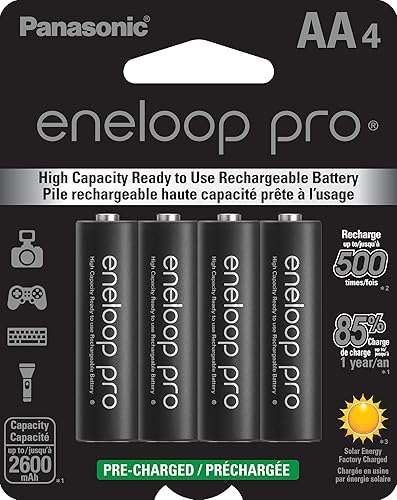
At a glance · Panasonic eneloop pro AA high capacity, 4 pack (BK-3HCCA4BA)
Best for: High-drain outage gear used every night: headlamps, bright flashlights and lanterns run on high
- Chemistry
- Low self-discharge NiMH, 1.2 V nominal, AA
- Capacity
- Up to 2,600 mAh (IEC 61951-2, Panasonic estimate; varies by region)
- Storage
- Retains up to 85% of charge after 1 year, unused and properly stored
- Recharge cycles
- Up to 500 (IEC 61951-2:2011 method); 150 under the 2017 method
- Cold rating
- Usable down to -4°F, with shorter runtime than at room temperature
- Pack
- 4 × AA (BK-3HCCA4BA); factory pre-charged
- USB charger
- Panasonic CC87: 4 eneloop pro AA in about 6 h
Verdict: The right cell when runtime per charge matters more than shelf life: lights that run every night of an outage. For a kit that sits for a year between storms, standard eneloop is the safer default.
In this review
This is a research-based review, based on manufacturer specs and published data. We do not test products. Specs come from Panasonic Energy Corporation of America's eneloop pro page and its Charger Technology sheet, checked November 1, 2026.
In a long outage, the battery question changes from 'will it work when I need it' to 'how long will it run tonight'. A headlamp on high or a lantern lighting the kitchen drains AA cells quickly, and more capacity per cell means fewer swaps in the dark and fewer charging sessions from your power station.
eneloop pro is Panasonic's answer for that kind of use. It lists up to 2,600 mAh per AA, against up to 2,100 mAh for standard eneloop. The cost is in two other numbers: up to 500 recharges instead of 2,100, and 85% charge retention after one year instead of 70% after ten.
Who should buy it
- Households that will run AA headlamps, flashlights or lanterns every night of an outage and recharge them every day or two.
- Anyone using bright AA gear on high, where capacity makes the most difference.
- People who already own a NiMH charger, ideally a USB one such as the Panasonic BQ-CC87.
Who should skip it
- Kits that sit untouched for a year or more. Standard eneloop holds up to 70% after 10 years, by Panasonic's estimate.
- Low-drain devices like clocks, remotes and weather radios on standby. Extra capacity buys little there.
- Safety alarms whose manuals specify alkaline cells, such as the Kidde COPD.
- Anyone without a charger. Without one, these are expensive single-use cells.
Strengths
- More capacity. Up to 2,600 mAh per AA, per Panasonic, about 24% more than standard eneloop's up to 2,100 mAh.
- Steady voltage. Panasonic says the design resists voltage drop during discharge, so lights stay bright until near the end of the charge.
- Holds a charge for a season. Up to 85% after 1 year, unused and properly stored.
- Cold-weather rating. Usable down to -4°F, with shorter runtime in the cold.
- Ready out of the box. Pre-charged at the factory.
Drawbacks
- Far fewer recharges. Up to 500 under the 2011 IEC method and 150 under the 2017 method, per Panasonic. Standard eneloop lists up to 2,100.
- Faster self-discharge. 85% after 1 year is good, but it is not standard eneloop's 70% after 10 years.
- Slower to charge. Panasonic's chart lists about 6 hours for four eneloop pro AA on the CC87, against 4.5 hours for standard eneloop.
- 1.2 V nominal. Lower than alkaline's 1.5 V. Most LED gear handles it, but check each device's manual.
- Model confusion. Panasonic also sells a newer BK-3HCCE version; check which one a listing ships.
How it compares
eneloop pro against the other AA options for an outage kit. Figures are from each manufacturer's page, checked November 1, 2026.
| Spec | Panasonic eneloop pro AA | Panasonic eneloop AA | Pale Blue AA USB-C | Energizer Ultimate Lithium AA |
|---|---|---|---|---|
| Type | NiMH rechargeable, 1.2 V | NiMH rechargeable, 1.2 V | Lithium-ion rechargeable, 1.5 V | Lithium single-use, 1.5 V |
| Capacity | Up to 2,600 mAh | Up to 2,100 mAh | 1,700 mAh (2,550 mWh) | Not listed on product page |
| Recharges | Up to 500 (2011 method) | Up to 2,100 (2011 method) | 1,000+ | Single use |
| Storage claim | 85% after 1 year | 70% after 10 years | About 12 months in a device | Up to 25 years |
| Charger | NiMH charger | NiMH charger | Built-in USB-C | None |
Using it in a long outage
Where pro cells earn their keep
Put eneloop pro in the devices that run hardest: the headlamp you wear while cooking, the AA lantern in the kitchen, the flashlight that goes outside to check the generator. Put standard eneloop or alkaline cells in the devices that mostly wait. That way the high-capacity cells cycle often, which suits their 500-cycle rating, and the long-storage cells sit in gear you seldom touch.
Capacity in plain terms
At 1.2 V, an eneloop pro AA at 2,600 mAh stores about 3.1 Wh, against about 2.5 Wh for standard eneloop and 2.55 Wh for Pale Blue's 1.5 V lithium-ion cell (our arithmetic from the makers' figures). In a device, that extra energy shows up as more hours on the same setting.
- 01Charge the set fully before storm season, since pro cells lose charge faster in storage.
- 02Recharge them every few months between outages.
- 03During an outage, charge from a power station or power bank with a USB charger like the CC87. Panasonic lists about 6 hours for four pro AA.
- 04Store at room temperature. Panasonic's storage figures assume about 68°F, and heat shortens them.
Ready.gov advises planning batteries and alternative power sources for outages. Our rechargeable batteries guide compares every AA option side by side, and the lanterns and flashlights chapter covers the lights they go in.
Frequently asked questions
- Is eneloop pro better than regular eneloop for emergencies?
- It depends on use. eneloop pro holds more charge per cell, up to 2,600 mAh, but Panasonic rates it for fewer recharges and 85% retention after 1 year, against 70% after 10 years for standard eneloop. For kits that sit for a long time, standard eneloop is the safer default.
- How long do eneloop pro batteries hold a charge?
- Panasonic says up to 85% of their charge after 1 year when unused and properly stored.
- How many times can eneloop pro be recharged?
- Up to 500 times under the IEC 61951-2:2011 method, and 150 under the 2017 method, per Panasonic.
- Can I charge eneloop pro from USB?
- Yes, with a USB-powered NiMH charger. Panasonic's CC87 charges four eneloop pro AA in about 6 hours from a USB cord.
- Did you test eneloop pro batteries?
- No. This is a research-based review, based on manufacturer specs and published data from Panasonic, the CDC and Ready.gov. We do not test products.
Sources
- Panasonic Energy Corporation of America, eneloop pro high-capacity rechargeable technology, checked November 1, 2026.
- Panasonic Energy Corporation of America, Charger Technology sheet (PDF), checked November 1, 2026.
- CDC, Proper Use of Candles During a Power Outage, last reviewed August 26, 2026.
- Ready.gov (FEMA), Power Outages, updated June 4, 2026.
This is a research-based review. PowerLockdown does not test products; specs come from the manufacturer and safety guidance from the public agencies cited. See our editorial policy.
Related guides
More lights, batteries and power banks reviews
Anker 737 Power Bank review: keeping phones and a laptop charged through an outage
Keeping two or three phones, a GMRS radio or a laptop charged for the first days of an outage, and refilling from a power station or car
Black Diamond Spot 400 review: hands-free light that runs on AAA batteries in an outage
Hands-free light for cooking, checking the breaker panel, caring for kids and moving around a dark house
Energizer 38511 review: a night light that switches on by itself the moment the power fails
Hallways, stairs and bedrooms: light that is already on when a night outage starts, so nobody walks into the dark
An evening lantern for a long outage that tops itself up on a windowsill during the day, with AA cells as backup
Households that want rechargeable AAs they can buy at any store, cycled through lights and radios during an outage
Go-bags, car kits and the backup-battery bag for flashlights and radios that may sit untouched for years
Energizer WeatheReady lantern review: 500 lumens of room light that runs for days on three D cells
The main room light for a household that stores disposable batteries, through an outage measured in days
Eton Blackout Buddy Swivel review: a slim wall light that comes on by itself when the power goes out
Bedrooms, hallways and offices: an automatic light at the moment the power fails, then a pocket flashlight
The kitchen or living room fixture you most want lit when the power fails at dinnertime
Fenix PD36R PRO review: a long-throw rechargeable flashlight for checking the yard and storm damage
Checking the yard, the roofline, a generator or downed branches after a storm, and finding the breaker panel fast
Goal Zero Lighthouse 600 review: a rechargeable room lantern with a crank for power outages
Lighting a kitchen or living room for the whole household every evening of a multi-day outage, without candles or fuel
Keeping one person's phone, headlamp and radio charged in a hurricane or flood outage, refilled from a small solar panel
Lepro 1500lm lantern review: the brightest room light on our list that runs on three D cells
Lighting a kitchen or living room bright enough to cook, read and work, during an outage of a few days
Keeping AA lights and radios running from a power bank or power station when you do not want a separate charger
Panasonic BQ-CC87 review: the USB charger that turns a power bank into AA batteries during an outage
Recharging NiMH AA and AAA cells from a power bank, power station or car USB port when the grid is down
Panasonic eneloop AA review: rechargeable batteries that hold a charge until the power goes out
Replacing the drawer of disposable AAs for radios, lanterns and remotes, recharged from a power station, power bank or solar during a long outage