Research-based review · Lights, batteries and power banks
Black Diamond Spot 400 review: hands-free light that runs on AAA batteries in an outage
400 lumens on high, 6 on low for up to 200 hours, a red night mode and IPX8 waterproofing. The low mode, not the high one, is what makes it an outage light.
By PowerLockdown EditorialUpdated November 1, 20265 min readBased on manufacturer specs and published dataHow we research
DisclosureAs an Amazon Associate we earn from qualifying purchases. We may earn a commission when you buy through links on this site, at no extra cost to you. Learn more.
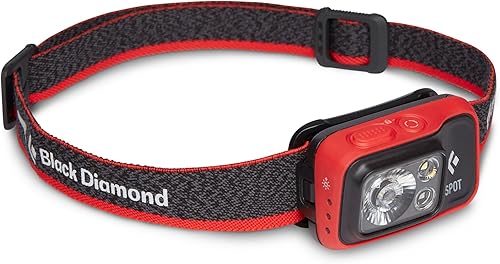
At a glance · Black Diamond Spot 400 Headlamp
Best for: Hands-free light for cooking, checking the breaker panel, caring for kids and moving around a dark house
- Output
- 400 lm high, 200 lm medium, 6 lm low
- Max distance
- 100 m high, 60 m medium, 12 m low
- Burn time (AAA / BD 1500)
- High 2.5 / 4 h; medium 5 / 8 h; low 200 / 225 h
- Power
- 3 AAA (included) or rechargeable BD 1500 Li-ion pack (sold separately)
- Water rating
- IPX8: operates at least 1.1 m underwater for 30 minutes
- Weight
- 86 g with AAA, 72 g with BD 1500
- Modes
- Proximity and distance, dimming, strobe, red night vision, lock mode, battery meter
Verdict: A light, waterproof headlamp that runs on common AAA cells, with a low mode that can last for days of evenings. Do not plan an outage around its 2.5-hour high setting.
In this review
This is a research-based review, based on manufacturer specs and published data. We do not test products. Specs come from Black Diamond's Spot 400 product page, checked November 1, 2026. Safety guidance comes from the CDC and Ready.gov.
A headlamp is the most useful single light in a power outage because it frees both hands. Ready.gov's power outage guidance says to have flashlights for every household member, and a headlamp counts. Cooking on an outdoor stove, resetting a breaker, reading a manual or changing a diaper all go faster with light pointed where you look.
The Spot 400 is one of the best-known headlamps from a major outdoor brand. Its Dual-Fuel design is the reason it suits outages: it runs on three standard AAA batteries or on Black Diamond's rechargeable BD 1500 pack.
Who should buy it
- Every household member who will be moving around the house after dark during an outage.
- Households that stock AA and AAA batteries: three AAA cells are included and easy to replace.
- People in flood and hurricane areas: IPX8 means Black Diamond rates it to operate at least 1.1 meters underwater for 30 minutes.
- Parents and caregivers who need a dim red light at night. The red mode has its own dimming and turns on without cycling through white light.
Who should skip it
- Anyone who needs to light a whole room for several people. A lantern such as the Goal Zero Lighthouse 600 spreads light better.
- People who need a long-throw beam to check a yard or a roofline. A flashlight like the Fenix PD36R PRO reaches far further than the Spot 400's 100 meters.
- Buyers who want built-in USB recharging out of the box. The BD 1500 rechargeable pack is sold separately.
Strengths
- Very long low mode. Up to 200 hours on AAA and 225 hours on the BD 1500 at 6 lumens, which is plenty for close tasks and moving around a room.
- Two battery options. Alkaline AAA cells or the rechargeable BD 1500 Li-ion pack, so you can use stored batteries or recharge from a power bank.
- Waterproof. IPX8. Black Diamond adds that if submerged, water may enter the battery compartment and the light will still operate, but it should be dried out afterward.
- Light and small. 86 g with AAA batteries.
- Useful controls. PowerTap for instant full brightness, brightness memory, a lock mode that prevents accidental switch-on in a bag, and a battery meter.
Drawbacks
- Short high-mode runtime. 2.5 hours on AAA at 400 lumens. Medium at 200 lumens doubles that to 5 hours. Use high only in short bursts.
- Rechargeable pack costs extra. The BD 1500 pack is sold separately.
- A spot, not a floodlight. It has a proximity mode for close work, but a headlamp lights what you look at, not the room.
- AAA, not AA. Many households stock AA for radios and lanterns. Buy AAA spares specifically, or the BD 1500 pack.
How it compares
The Spot 400 against a rechargeable flashlight and a rechargeable lantern, the other two lights most households pair it with. Figures are from each manufacturer's page.
| Spec | Black Diamond Spot 400 | Fenix PD36R PRO | Goal Zero Lighthouse 600 |
|---|---|---|---|
| Type | Headlamp | Handheld flashlight | Room lantern |
| Max output | 400 lm | 2,800 lm | 600 lm |
| Longest runtime | 200 h (AAA, low) | 42 h (lowest mode) | 320 h (one side, low) |
| Power | 3 AAA or BD 1500 pack | 5,000 mAh 21700 Li-ion | 18.98 Wh Li-ion, crank, USB |
| Water rating | IPX8 (1.1 m, 30 min) | Waterproof to 2 m | Not listed |
| Weight | 86 g (AAA) | 169 g | 498 g |
Using it in a long outage
Budget batteries for a long outage
Work from Black Diamond's burn times. If one person uses the medium setting for 2 hours each evening, one set of AAA cells lasts about 2.5 evenings (5 hours ÷ 2). On the 6-lumen low setting, the same set can cover roughly a hundred evenings at 2 hours each (200 hours ÷ 2). That gap is why the low and medium modes matter more than the 400-lumen headline. For a 30-day outage, a household of four using medium for 2 hours a night needs about 12 sets of three AAA cells per person, or a rechargeable plan.
Rechargeable cuts the pile of disposable cells you need to store. A BD 1500 pack charged from a power bank or a small power station gives 8 hours on medium per charge. Rechargeable Ni-MH AAA cells are another option; our eneloop review covers the AA versions and a USB-powered charger.
Where to keep them
- One headlamp per person, kept by each bed with the lock mode on so it does not drain in a drawer.
- One in the kitchen drawer nearest the breaker panel.
- One in each car and go-bag.
- Spare AAA cells in a labeled bag with the purchase date. Check the battery meter at each daylight saving time change.
Use the red mode, which Black Diamond calls its night-vision mode, when checking on children or someone who is ill at night: it can be dimmed and turns on without a flash of white light. If you cook during an outage, use the headlamp to cook outdoors; never bring a camp stove or grill indoors, because both produce carbon monoxide (CDC).
Frequently asked questions
- How long does the Black Diamond Spot 400 last on AAA batteries?
- Black Diamond lists 2.5 hours on high (400 lumens), 5 hours on medium (200 lumens) and 200 hours on low (6 lumens) with AAA batteries. With the BD 1500 rechargeable pack the figures are 4, 8 and 225 hours.
- Is the Spot 400 rechargeable?
- It can be. It runs on three AAA batteries, which are included, or on Black Diamond's BD 1500 Li-ion rechargeable pack, which is sold separately.
- Is the Spot 400 waterproof?
- Yes. Black Diamond rates it IPX8, able to operate at least 1.1 meters underwater for 30 minutes. If it gets submerged, dry the battery compartment out afterward.
- Is a headlamp or a lantern better in a power outage?
- You want both. A headlamp lights tasks hands-free, and a lantern lights a room for everyone. CDC recommends battery-powered lights instead of candles.
- Did you test the Spot 400?
- No. This is a research-based review, based on manufacturer specs and published data from Black Diamond, CDC and Ready.gov. We do not test products.
Sources
- Black Diamond Equipment, Spot 400 Headlamp: features and specs, checked November 1, 2026.
- CDC, Proper Use of Candles During a Power Outage, last reviewed August 26, 2026.
- Ready.gov (FEMA), Power Outages, updated June 4, 2026.
- CDC, About Carbon Monoxide Poisoning, reviewed October 2026.
This is a research-based review. PowerLockdown does not test products; specs come from the manufacturer and safety guidance from the public agencies cited. See our editorial policy.
Related guides
More lights, batteries and power banks reviews
Anker 737 Power Bank review: keeping phones and a laptop charged through an outage
Keeping two or three phones, a GMRS radio or a laptop charged for the first days of an outage, and refilling from a power station or car
Energizer 38511 review: a night light that switches on by itself the moment the power fails
Hallways, stairs and bedrooms: light that is already on when a night outage starts, so nobody walks into the dark
An evening lantern for a long outage that tops itself up on a windowsill during the day, with AA cells as backup
Households that want rechargeable AAs they can buy at any store, cycled through lights and radios during an outage
Go-bags, car kits and the backup-battery bag for flashlights and radios that may sit untouched for years
Energizer WeatheReady lantern review: 500 lumens of room light that runs for days on three D cells
The main room light for a household that stores disposable batteries, through an outage measured in days
Eton Blackout Buddy Swivel review: a slim wall light that comes on by itself when the power goes out
Bedrooms, hallways and offices: an automatic light at the moment the power fails, then a pocket flashlight
The kitchen or living room fixture you most want lit when the power fails at dinnertime
Fenix PD36R PRO review: a long-throw rechargeable flashlight for checking the yard and storm damage
Checking the yard, the roofline, a generator or downed branches after a storm, and finding the breaker panel fast
Goal Zero Lighthouse 600 review: a rechargeable room lantern with a crank for power outages
Lighting a kitchen or living room for the whole household every evening of a multi-day outage, without candles or fuel
Keeping one person's phone, headlamp and radio charged in a hurricane or flood outage, refilled from a small solar panel
Lepro 1500lm lantern review: the brightest room light on our list that runs on three D cells
Lighting a kitchen or living room bright enough to cook, read and work, during an outage of a few days
Keeping AA lights and radios running from a power bank or power station when you do not want a separate charger
Panasonic BQ-CC87 review: the USB charger that turns a power bank into AA batteries during an outage
Recharging NiMH AA and AAA cells from a power bank, power station or car USB port when the grid is down
Panasonic eneloop AA review: rechargeable batteries that hold a charge until the power goes out
Replacing the drawer of disposable AAs for radios, lanterns and remotes, recharged from a power station, power bank or solar during a long outage
High-drain outage gear used every night: headlamps, bright flashlights and lanterns run on high