Guides · Gear picks
Best battery backup for a WiFi router
A modem and router draw only a few watts, so a small battery keeps the internet up for hours. Whether there is still a signal to connect to depends on your provider.
Photo: Sung Jin Cho / Unsplash
By PowerLockdown EditorialUpdated November 1, 20269 min readHow we research
In this guide
DisclosureAs an Amazon Associate we earn from qualifying purchases. We may earn a commission when you buy through links on this site, at no extra cost to you. Learn more.
The short answer
For a modem and router, a small UPS such as the APC Back-UPS 600VA (BE600M1) or CyberPower CP685AVRG covers short outages and protects gear from surges. For outages measured in hours or days, a portable power station with a UPS-style switchover does better. Add up your devices' watts and divide your battery's usable watt-hours by that total.
A home internet connection usually runs through two or three boxes: the modem or fiber optical network terminal (ONT), the WiFi router, and sometimes a mesh node or a VoIP phone adapter. All of them stop when the outlet does. A battery backup keeps them up through brief flickers, which also spares you the several-minute reboot that follows each one.
At a glance
| Model | Type | Capacity | Battery-backed outlets | Best for |
|---|---|---|---|---|
| APC Back-UPS 600VA (BE600M1) | Standby UPS | 600 VA / 330 W | 5 | Modem + router, short outages |
| CyberPower CP685AVRG | Line-interactive UPS | 685 VA / 390 W | 4 | Areas with brownouts |
| APC Back-UPS Pro 1500S (BR1500MS2) | Line-interactive, sine wave | 1,500 VA / 900 W | 6 | Network gear plus a mesh node |
| CyberPower CP1500PFCLCD | Line-interactive, sine wave | 1,500 VA / 1,000 W | 6 | Network gear plus a desktop |
| EcoFlow RIVER 3 Plus | Power station | 286 Wh | 3 AC | Router through a long evening |
| Anker SOLIX C1000 | Power station | 1,056 Wh | 6 AC | Router for a day or more, plus a fridge |
UPS picks
The two UPS units most people should start with have full write-ups: read the full BE600M1 review and read the full CP685AVRG review.

No. 1UPS
APC Back-UPS 600VA (BE600M1)
Best for: A compact, low-cost UPS for a modem and router on a shelf
- 600 VA / 330 W
- 7 outlets: 5 battery-backed, 2 surge-only
- 1 USB-A charging port
- 12 V lead-acid battery; about 10 hrs typical recharge
- 6 ms typical transfer time; stepped sine wave output
- Replacement battery: APC APCRBC154; 490 J surge rating
- 7.69 lb; 3-year UPS warranty, 1-year battery warranty
Tradeoffs
- Stepped (not pure) sine wave output, which is fine for most network gear
- One small lead-acid battery, so expect a few hours at most for a modem and router
No. 2UPS
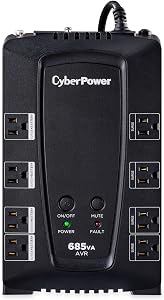
CyberPower CP685AVRG AVR UPS
Best for: A small line-interactive UPS with voltage regulation for brownout-prone areas
- 685 VA / 390 W; line-interactive with automatic voltage regulation
- 8 outlets: 4 battery-backed, 4 surge-only
- 12 V / 7 Ah sealed lead-acid battery, user replaceable
- Maker runtime: 11 min at half load, 2 min at full load; 8 hrs typical recharge
- 4 ms typical transfer time; replacement battery RB1270B or RB1280, by serial number
- 11.62 lb; 3-year warranty including batteries
Tradeoffs
- Simulated sine wave output on battery
- Only four battery-backed outlets
No. 3UPS
APC Back-UPS Pro 1500S (BR1500MS2)
Best for: Longer runtime for a modem, router, ONT and a mesh node, with a pure sine wave
- 1,500 VA / 900 W; line-interactive, sine wave output, AVR
- 8 ms typical transfer time; replacement battery APC APCRBC163
- 10 outlets: 6 battery-backed, 4 surge-only
- USB-A and USB-C charging ports; LCD status console
- Lead-acid battery, user replaceable; about 16 hrs typical recharge
- 27.6 lb; 3-year UPS warranty, 1-year battery warranty
Tradeoffs
- Heavy and large for a network shelf
- 16-hour recharge means a second outage soon after the first finds it partly charged

No. 4UPS
CyberPower CP1500PFCLCD PFC Sinewave UPS
Best for: Two batteries' worth of runtime for network gear plus a desktop computer
- 1,500 VA / 1,000 W; line-interactive, sine wave output
- 12 outlets: 6 battery-backed, 6 surge-only
- Two 12 V / 9 Ah sealed lead-acid batteries, user replaceable
- Maker runtime: 10 min at half load, 2.5 min at full load; 8 hrs typical recharge
- 4 ms typical transfer time; replacement battery RB1290X2 or RB1280X2B, by serial number
- USB-A and USB-C charge ports; tilting LCD
- 24.9 lb; 3-year warranty including batteries
Tradeoffs
- Overkill if you only need to run a modem and router
- About 25 lb
Power station picks for longer outages
- 01Small and lightEcoFlow RIVER 3 Plus

Keeping a modem and router online through an evening or a night
- Capacity
- 286 Wh
- Cont./surge
- 600 / 1,200 W
- Chem./fuel
- LiFePO4 (LFP)
- Weight
- 10.4 lb
- 02All-day backupAnker SOLIX C1000

Running the internet for a day or more while also powering a fridge or lights
- Capacity
- 1,056 Wh
- Cont./surge
- 1,800 / 2,400 W
- Chem./fuel
- LiFePO4
- Weight
- 28.44 lb
No. 1Small and light
EcoFlow RIVER 3 Plus
Best for: Keeping a modem and router online through an evening or a night
At 286 Wh and 10.4 lb, the RIVER 3 Plus holds several times the energy of a small lead-acid UPS. EcoFlow lists a sub-10 ms UPS switchover, so it can sit between the wall and your network gear full time.
Strengths
- Under 10 ms switchover per EcoFlow
- LiFePO4 rated for 3,000 cycles to 80%
- Expands to 858 Wh
Tradeoffs
- Only three AC outlets
- Small for anything beyond network gear and phones
- Note: X-Boost runs some higher-watt resistive devices at reduced power (up to 1,200 W per EcoFlow).
| Capacity | 286 Wh |
| AC output | 600 W continuous / 1,200 W surge |
| Battery | LiFePO4 (LFP) |
| Weight | 10.4 lb |
| Max solar input | 220 W |
| Rated cycles | 3,000 cycles to 80% |
| AC outlets | 3 |
| UPS switchover | <10 ms |
| Expansion | Up to 858 Wh with an EcoFlow extra battery |
No. 2All-day backup
Anker SOLIX C1000
Best for: Running the internet for a day or more while also powering a fridge or lights
1,056 Wh is enough to run a typical modem and router for a day or more on our math below, with capacity left for phones and lights. Anker lists a switchover under 20 ms.
Strengths
- Six AC outlets
- Expandable to 2,112 Wh
- Solar input up to 600 W
Tradeoffs
- About 28 lb
- Its sub-20 ms switchover is slower than a standby UPS; most routers ride through it, but check yours
- Note: A newer C1000 Gen 2 has different specs. Make sure the listing matches the model you want.
| Capacity | 1,056 Wh |
| AC output | 1,800 W continuous / 2,400 W surge |
| Battery | LiFePO4 |
| Weight | 28.44 lb |
| Max solar input | 600 W |
| Rated cycles | 3,000 cycles to 80%+ |
| AC outlets | 6 |
| Expansion | Up to 2,112 Wh with the matching expansion battery |
Battery backup for modem and router: the runtime math
Every power adapter lists its output on the label, for example 12 V and 1.5 A. Multiply to get the maximum watts: 12 x 1.5 = 18 W. That figure is a ceiling; the device usually draws less. Add the ceilings for each box you need, then do the division.
| Setup (label maximums) | Total watts | 286 Wh station | 1,056 Wh station |
|---|---|---|---|
| ONT 12 W + router 18 W | 30 W | About 8 hours | About 30 hours |
| Cable modem 12 W + router 18 W + mesh node 12 W | 42 W | About 6 hours | About 21 hours |
| ONT 12 W + router 18 W + VoIP adapter 6 W | 36 W | About 7 hours | About 25 hours |
Lead-acid UPS batteries are smaller and deliver a lower share of their rating. The CyberPower CP685AVRG has one 12 V, 7 Ah battery, which is 84 Wh nominal. The CP1500PFCLCD has two 12 V, 9 Ah batteries, 216 Wh nominal. CyberPower quotes runtime at half and full load (11 and 2 minutes for the CP685AVRG), which tells you little about a 30 W load. Use the maker's runtime chart or CyberPower's online runtime calculator for your actual watts.
If you want a full-home estimate that includes the router, a fridge and medical devices, the BackupPowerAI sizing quiz adds them up.
Battery backup for internet: what the box cannot fix
Your router can stay on and still have nothing to connect to. Cable and DSL service runs through powered equipment outside your home, and the cell towers that carry 5G home internet need power too. Any of it can go down in a wide or long outage. A battery backup for internet protects you from the outage at your house, not from one across your provider's network.
If your home phone runs over fiber, cable or VoIP, it also needs power. The FCC requires providers of these non-line-powered home voice services to offer for sale at least one backup power option with 8 hours of standby power, and since February 13, 2019, an option with at least 24 hours. Buying it is your choice. Providers must also disclose at the point of sale and each year how long backup lasts and how to test it.
Choosing between a UPS and a power station
- Switchover speed: a UPS is designed to switch in milliseconds. The APC BE600M1 lists 6 ms typical and 10 ms maximum. Some power stations list UPS switchover times under 10 or 20 ms; others list none.
- Capacity: a lead-acid UPS stores tens to a couple hundred watt-hours. A small power station stores roughly 300 Wh, a mid-size one about 1,000 Wh.
- Battery life: APC lists 3 to 5 years of battery life for the BE600M1. The LiFePO4 stations here are rated for thousands of cycles.
- Waveform: pure sine wave output (BR1500MS2, CP1500PFCLCD, power stations) suits any device. Stepped or simulated sine wave output (BE600M1, CP685AVRG on battery) is generally fine for network adapters.
- Recharge: APC lists 10 hours to recharge the BE600M1 and 16 hours for the BR1500MS2. A power station can refill from a car or solar panels during a long outage.
Setup tips
- 01Plug the modem or ONT, router and any VoIP adapter into the battery-backed outlets, not the surge-only ones. Label them.
- 02Leave printers, monitors and speakers on surge-only outlets so they do not drain the battery.
- 03If your fiber ONT has its own provider battery unit, keep it; a UPS upstream extends it.
- 04Pull the plug once a season to confirm everything stays up and to see how the UPS reports remaining time.
- 05Keep phones charged too. Our phone charging guide and radios and power banks kit cover that side.
Frequently asked questions
- How long will a UPS run a modem and router?
- It depends on the battery size and your watts. A small UPS like the CyberPower CP685AVRG has one 12 V, 7 Ah battery (84 Wh nominal), and lead-acid delivers less than its nominal rating, so check the maker's runtime chart for your load. A 286 Wh power station runs a 30 W setup for about 8 hours on our math.
- Will my internet work during a power outage if my router has battery backup?
- Only if your provider's network is still powered. Cable, DSL, fiber and cellular service all depend on equipment outside your home, and that equipment can lose power in a wide or long outage. Check your provider's outage map or call it.
- Can I use a portable power station as a UPS for my router?
- Many power stations offer pass-through charging with an automatic switchover. EcoFlow lists under 10 ms for the RIVER 3 Plus and Anker lists under 20 ms for the SOLIX C1000. Most network gear rides through that, but check yours by unplugging the station from the wall.
- Does my provider have to give me backup power for my home phone?
- Providers of fiber, cable and VoIP home phone service must offer backup power for sale: an 8-hour option, and since February 13, 2019, a 24-hour option. They do not have to provide it free, and buying it is optional, per the FCC.
- What is the best battery backup for a modem and router?
- For short outages, a compact UPS like the APC BE600M1 or CyberPower CP685AVRG. For multi-hour outages, a power station such as the EcoFlow RIVER 3 Plus holds several times more energy.
Sources
- Federal Communications Commission, PSHSB Reminds Providers of Requirement to Offer 24 Hours of Backup Power for Customer Premises Equipment (DA 18-1205), November 27, 2018.
- APC by Schneider Electric, APC Back-UPS 600VA (BE600M1) product data sheet, generated October 31, 2026.
- APC by Schneider Electric, APC Back-UPS Pro 1500S (BR1500MS2) product data sheet, accessed November 1, 2026.
- CyberPower Systems, CP685AVRG AVR UPS specifications, accessed November 1, 2026.
- CyberPower Systems, CP1500PFCLCD PFC Sinewave UPS specifications, accessed November 1, 2026.
- Ready.gov (FEMA), Power Outages, updated June 4, 2026.
Related guides
Quick answers
How to charge your phone during a power outage
Your phone is your alert system, flashlight and family check-in. Keeping it alive is mostly about using less power, then having two ways to put power back in.
Updated November 1, 2026 · 8 min read
Gear picks
Best emergency radios for power outages
Five research-based picks for hand-crank, solar and battery NOAA weather radios, chosen from manufacturer specs and published data.
Updated October 27, 2026 · 8 min read
Gear picks
Best CPAP battery backup for power outages
A CPAP uses little power, so a modest battery can cover a night or more. The two things that change the math are the heated humidifier and whether you connect by DC or AC.
Updated November 1, 2026 · 9 min read
Outage basics
How long power outages last: what federal data shows
What federal data says about outage length in the US, why a few big storms dominate the numbers, and how to decide how many days to prepare for.
Updated October 27, 2026 · 7 min read
Quick answers
How to get electricity during a power outage
When the grid is down, electricity comes from two places: energy you stored before the outage, or fuel you burn during it. Here are the options from smallest to largest, and what each one can realistically run.
Updated November 1, 2026 · 8 min read