Research-based review · UPS and internet backup
CyberPower CP685AVRG review: a small UPS for a modem and router in brownout-prone areas
A compact 685 VA line-interactive UPS with voltage regulation, four battery-backed outlets and one 12 V, 7 Ah battery covered by a 3-year warranty.
By PowerLockdown EditorialUpdated November 1, 20266 min readBased on manufacturer specs and published dataHow we research
DisclosureAs an Amazon Associate we earn from qualifying purchases. We may earn a commission when you buy through links on this site, at no extra cost to you. Learn more.
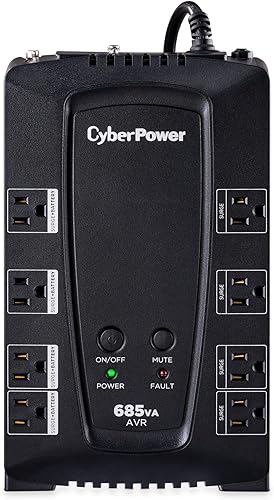
At a glance · CyberPower CP685AVRG AVR UPS
Best for: Keeping a modem or ONT, a router and a VoIP adapter online through flickers, brownouts and short outages, on a shelf or wall mount
- Capacity
- 685 VA / 390 W
- Topology
- Line-interactive with AVR (single boost)
- Waveform
- Sine wave on AC; simulated sine wave on battery
- Outlets
- 8 × NEMA 5-15R: 4 battery-backed, 4 surge-only; 4 widely spaced
- Transfer time
- 4 ms typical
- Battery
- 12 V / 7 Ah sealed lead-acid, user replaceable (RB1270B or RB1280 by serial number)
- Maker runtime
- 11 min at half load, 2 min at full load; 8 h typical recharge
- Weight and warranty
- 11.62 lb; 3 years including the battery
Verdict: The small UPS to choose if your power sags as often as it fails. AVR spares the battery during brownouts, and the battery warranty is three times APC's. Like any lead-acid UPS, it bridges short outages, not long ones.
In this review
This is a research-based review, based on manufacturer specs and published data. We do not test products. Figures come from CyberPower's CP685AVRG product page and specifications, checked November 1, 2026, and from the FCC, EPA and Ready.gov sources cited below.
The CP685AVRG sits in the same small-UPS slot as the APC BE600M1, with one meaningful difference. CyberPower lists it as line-interactive with automatic voltage regulation (AVR). When incoming voltage sags, the unit boosts it on its transformer instead of switching to battery. In neighborhoods where storms, heat waves or heavy demand bring dimming lights before an outage, that saves the battery for when it is really needed.
Its battery is a single 12 V, 7 Ah sealed lead-acid block, about 84 Wh nominal. That is enough to keep network gear running through short outages and flickers. It is not enough for a night, and this review explains how to plan around that.
Who should buy it
- Homes with frequent brownouts or voltage swings, where a standby UPS would keep clicking over to battery.
- Anyone who wants the modem, router and VoIP adapter to stay up through flickers without the reboot that follows each one.
- Small spaces: it is 11 × 6.8 × 3.5 inches with keyhole slots for wall mounting.
- Buyers who want the battery under warranty: CyberPower's 3-year warranty includes it.
Who should skip it
- Desktop computers that need sine wave power on battery. The CyberPower CP1500PFCLCD outputs a sine wave in both modes.
- Anyone who needs the internet up through a whole night or several days. A lithium station such as the EcoFlow RIVER 3 Plus holds more than three times the nominal energy.
- Setups with more than four devices to keep powered. Only four outlets are battery-backed.
Strengths
- AVR on a small UPS. CyberPower lists single-boost voltage regulation that corrects minor sags without using the battery.
- 4 ms typical transfer time, faster than the 6 ms APC lists for the BE600M1.
- 3-year warranty including the battery, plus CyberPower's lifetime Connected Equipment Guarantee.
- Four widely spaced outlets for bulky power adapters, so a router brick does not block its neighbor.
- 8-hour typical recharge, shorter than APC's 10 hours for the BE600M1.
- Wall mountable with keyhole slots, and CyberPower lists an ultra-quiet design.
Drawbacks
- Simulated sine wave on battery. Fine for modems, routers and phone adapters with external bricks; not ideal for some computers.
- Four battery-backed outlets. A modem, router, mesh node and VoIP adapter fill them.
- Small battery. 84 Wh nominal, and lead-acid delivers less than its rating at high draw and loses capacity with age.
- No USB charge port. Phones need another source during the outage.
How it compares
The CP685AVRG against APC's small unit, CyberPower's larger sine wave model and a small lithium station. Figures are from each maker's page.
| Spec | CyberPower CP685AVRG | APC Back-UPS 600VA (BE600M1) | CyberPower CP1500PFCLCD | EcoFlow RIVER 3 Plus |
|---|---|---|---|---|
| Rated output | 685 VA / 390 W | 600 VA / 330 W | 1,500 VA / 1,000 W | 600 W |
| Voltage regulation | AVR | None (standby) | AVR | Not applicable |
| Battery-backed outlets | 4 | 5 | 6 | 3 AC |
| Battery | 12 V / 7 Ah lead-acid | 12 V lead-acid | 2 × 12 V / 9 Ah lead-acid | 286 Wh LiFePO4 |
| Waveform on battery | Simulated sine | Stepped sine | Sine wave | Pure sine |
| Battery warranty | 3 years | 1 year | 3 years | Whole-unit warranty |
Using it in a long outage
How long it runs network gear
CyberPower's 11 minutes at half load means about 195 W, the load of a small computer. A modem and router are far lighter: label maximums of 20 to 40 W are common, and actual draw is lower. At those loads the battery lasts much longer than the box figure, but how much longer depends on the battery's age and temperature. CyberPower's online runtime calculator gives an estimate for your exact watts. Do not simply divide 84 Wh by your load: lead-acid cells and the inverter both lose energy.
Our router backup guide works the same math for lithium stations: a 286 Wh unit runs a 30 W setup about 8 hours. Use the CP685AVRG for the first minutes of any outage and the flickers in between, and have a larger battery ready for long ones.
Setup routine
- 01Plug the UPS straight into a wall outlet. Do not daisy-chain it from a surge strip, extension cord or another UPS.
- 02Put the modem or ONT, router and VoIP adapter on the battery-backed outlets, and printers or speakers on the surge-only side.
- 03Keep laser printers, space heaters and other high-draw devices off it. CyberPower lists them among devices that void the warranty.
- 04Once a season, unplug the UPS from the wall for a few minutes, confirm the internet stays up, and listen for the battery-mode alarm.
- 05Keep phones charged separately, since there is no USB port; see how to charge your phone during a power outage.
Pairing with a power station
If an outage outlasts the battery, plug the UPS into a pure sine power station such as the Jackery Explorer 300 v2 or the Anker SOLIX C1000. The station supplies the hours and the UPS keeps its fast switchover for when grid power returns and drops again.
Frequently asked questions
- How long will the CyberPower CP685AVRG run a modem and router?
- Longer than the box figures, which are 11 minutes at half load and 2 minutes at full load. A modem and router draw far less than half load. Use CyberPower's runtime calculator with your actual watts; an older battery runs shorter.
- What replacement battery does the CP685AVRG use?
- CyberPower lists RB1270B for serial numbers containing CXA and RB1280 for serial numbers beginning with BGP or BFA. The battery is user replaceable.
- Is the CP685AVRG pure sine wave?
- No. CyberPower lists sine wave output on AC but a simulated sine wave on battery. That suits modems, routers and VoIP adapters. For a desktop that needs sine wave power, look at the CP1500PFCLCD.
- Why does my CyberPower CP685AVRG beep?
- CyberPower lists audible alarms for battery mode, low battery and overload. A beep on battery means the power is out or voltage is outside what AVR can correct; a steady overload alarm means too much is plugged in.
- Did you test the CyberPower CP685AVRG?
- No. This is a research-based review, based on CyberPower's specifications and published data from the FCC, EPA and Ready.gov. We do not test products.
Sources
- CyberPower Systems, CP685AVRG AVR UPS: overview and specifications, checked November 1, 2026.
- Federal Communications Commission, Requirement to Offer 24 Hours of Backup Power for Customer Premises Equipment (DA 18-1205), November 27, 2018.
- U.S. EPA, Used Household Batteries, updated July 21, 2026.
- Ready.gov (FEMA), Power Outages, updated June 4, 2026.
This is a research-based review. PowerLockdown does not test products; specs come from the manufacturer and safety guidance from the public agencies cited. See our editorial policy.
Related guides
More ups and internet backup reviews
APC Back-UPS 600VA (BE600M1) review: keeping a modem and router up through short outages
Keeping a modem, router and VoIP adapter online through brief outages and flickers, and saving the several-minute reboot that follows each one
APC Back-UPS Pro 1500S (BR1500MS2) review: sine wave backup for a home network and a desktop
A home office or network closet that needs sine wave output, brownout correction and time to shut a desktop down cleanly when the power fails
CyberPower CP1500PFCLCD review: sine wave backup for a desktop and the home network
A desktop computer plus modem and router that need sine wave power, a few minutes to shut down cleanly, and protection through flickers and brownouts