Research-based review · Water storage and treatment
Platypus GravityWorks 4.0L review: filtering a family's daily water without pumping
Fill the dirty bag, hang it, and gravity pushes up to 1.75 liters a minute through a 0.2-micron filter. Built for volume, with the same virus gap as other filters.
By PowerLockdown EditorialUpdated November 1, 20265 min readBased on manufacturer specs and published dataHow we research
DisclosureAs an Amazon Associate we earn from qualifying purchases. We may earn a commission when you buy through links on this site, at no extra cost to you. Learn more.
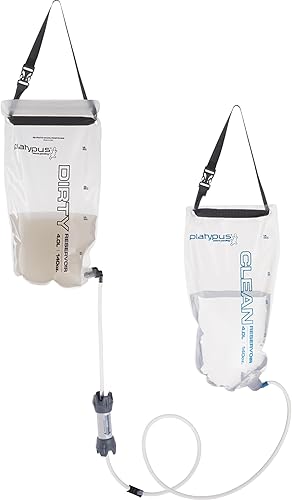
At a glance · Platypus GravityWorks Water Filter System, 4.0 L
Best for: Households that will collect rain, well or surface water in a long outage and need several gallons filtered every day
- Filter
- 0.2-micron hollow fiber
- Flow
- Up to 1.75 L per minute (maker)
- Filter life
- Up to 1,500 L (about 396 gallons, our conversion)
- Removes (maker)
- 99.9999% of bacteria and 99.9% of protozoa; not effective against viruses or chemicals
- Reservoirs
- 4.0 L dirty + 4.0 L clean (8 L total)
- Weight
- 11.5 oz (326 g) system
- Includes
- Both reservoirs, microfilter, hoses, shutoff clamp, storage sack
Verdict: The easiest way to filter household volumes without power or effort. Treat it as the bacteria-and-protozoa step, and disinfect afterward when viruses are a concern.
In this review
This is a research-based review, based on manufacturer specs and published data. We do not test products. Specs come from the Cascade Designs product page and FAQ for the Platypus GravityWorks Water Filter System, checked November 1, 2026. Treatment guidance comes from the CDC.
A family of four needs at least 4 gallons, about 15 liters, of drinking and cooking water a day by the CDC's 1 gallon per person baseline. Squeeze filters and straws can do that, but slowly and by hand. A gravity filter does the work while you do something else: fill the dirty reservoir, hang it higher than the clean one, open the clamp, and water runs through the filter into the clean bag.
The GravityWorks is one of the best-known gravity systems. The 4.0 L size is reviewed here; Platypus also sells a 6.0 L version with the same filter.
Who should buy it
- Households planning for outages long enough that stored water will run out, especially on private wells that stop without power.
- Families who want to filter collected rainwater or nearby surface water in batches every day.
- Anyone who finds squeeze filters tiring or has limited hand strength.
Who should skip it
- Single go-bag use. At 11.5 oz it is light, but a squeeze filter such as the Sawyer Squeeze is smaller and simpler for one person.
- Anyone who needs virus protection without a second step. The maker's spec table says it is not effective against viruses.
- Situations with chemical contamination, such as floodwater with fuel. The maker's table says it is not effective against chemicals or toxins.
Strengths
- Hands-free volume. Up to 1.75 L a minute by the maker's figure, so a 4 L batch takes a few minutes of hanging time.
- Clean and dirty sides stay separate. The system includes a dedicated clean reservoir, which reduces the chance of recontaminating filtered water.
- Stated filter life. Up to 1,500 L, about 100 days of drinking water for a family of four at 15 L a day, by our arithmetic.
- Field cleanable. The maker says the filter backflushes in about 4 seconds, and recommends backflushing a quarter liter for every 6 L filtered.
- Light to store. 11.5 oz and smaller than most 1 L bottles when packed, by the maker's description.
Drawbacks
- No virus protection. The maker lists viruses as not covered. Boil or chemically disinfect when that matters.
- Freezing damages it. Cascade Designs warns that a used, wet hollow-fiber filter can freeze and break its fibers permanently. In a winter outage, keep it inside and warm.
- Murky water clogs it. The maker's FAQ calls tea-colored water hard on all filters and recommends finding another source if you can.
- Bag durability. Soft reservoirs can puncture; store them away from sharp tools.
- Stock gaps. The maker's store showed both sizes out of stock when we checked; Amazon availability may differ.
How it compares
Gravity, squeeze and chemical treatment each fit a different part of a household water plan.
| Spec | Platypus GravityWorks 4.0 L | Sawyer Squeeze | Katadyn Micropur MP1 |
|---|---|---|---|
| Method | Hanging gravity filter | Squeeze or gravity filter | Chlorine dioxide tablet |
| Pore size | 0.2 micron | 0.1 micron absolute | Not a filter |
| Viruses | No (maker) | No claim | Yes (EPA label) |
| Rated volume | Up to 1,500 L | Not stated | 1 L per tablet |
| Best role | Daily household volume | Go-bags and backup | Virus step and backup |
Using it in a long outage
A daily water routine
- 01Collect water in the morning and let it settle in a bucket so sediment drops out.
- 02Pour the clear top layer into the dirty reservoir, hang it from a hook or door frame, and set the clean reservoir below.
- 03Open the clamp and let it run. Repeat until you have the day's water.
- 04If viruses are a concern, disinfect the filtered water. The CDC advises filtering first, then disinfecting: 8 drops of unscented household chlorine bleach per gallon of clear water, wait 30 minutes.
- 05Backflush about a quarter liter for every 6 L filtered, per the maker, and bring the filter indoors at night in cold weather.
Rainwater and wells
Roof runoff picks up debris and bird droppings, so discard the first flush of a storm, collect into a clean food-grade container such as a Jumbo-Tainer, then filter and disinfect. For a well that has lost its pump, a hand bucket or bailer gets water up; filter it the same way. Our guide to water when the taps stop covers collection in more detail.
Frequently asked questions
- Does the Platypus GravityWorks remove viruses?
- No. Cascade Designs' spec table lists it as not effective against viruses. Disinfect filtered water with bleach or chlorine dioxide tablets, or boil it, when viruses are a concern.
- How much water can the GravityWorks filter in a day?
- The maker lists a flow of up to 1.75 liters per minute and a filter life of up to 1,500 liters. A family's 15 liters a day is a few batches of the 4.0 L reservoir. Flow slows as the filter loads, so backflush regularly.
- Can the GravityWorks freeze?
- Cascade Designs warns that a used filter holds water in its hollow fibers, which can freeze and break, permanently damaging it. Keep it indoors and above freezing, and inspect it if it may have frozen.
- Did you test the GravityWorks?
- No. This is a research-based review, based on manufacturer specs and published data from the CDC. We do not test products.
Sources
- Cascade Designs (Platypus), GravityWorks Water Filter System: tech specs and FAQ, checked November 1, 2026.
- CDC, Water Treatment Options When Hiking, Camping or Traveling, January 30, 2025.
- CDC, Making Water Safe in an Emergency, July 22, 2024.
- CDC, Creating and Storing an Emergency Water Supply, June 27, 2025.
This is a research-based review. PowerLockdown does not test products; specs come from the manufacturer and safety guidance from the public agencies cited. See our editorial policy.
Related guides
More water storage and treatment reviews
Aquamira Water Treatment review: keeping stored emergency water fresh, not purifying unsafe water
Households storing their own tap water in drums or jugs who want to keep it from going stale between rotations
Katadyn Micropur MP1 review: purifier tablets that cover the virus gap filters leave
The disinfection step after a filter, a backup when you cannot boil, and every go-bag
LifeStraw Personal Water Filter review: a go-bag backup for drinking water away from home
Go-bags, car kits and evacuation, where one person may need to drink from a doubtful source
MSR AutoFlow XL review: a family's daily drinking water when the taps are unsafe
Households on a well, rain barrel or questionable tap water that need several gallons of filtered water a day without power
Reliance Jumbo-Tainer 7 Gallon review: rigid jugs you can store, carry and refill in an outage
Building a 2-week water supply in containers you can lift, move to a car, or carry to a refill point
Sawyer Squeeze review: a pocket filter for making collected water safer when the taps fail
Filtering rain, well, pond or creek water once stored water runs low, and a go-bag filter for every adult
waterBOB review: filling the bathtub with drinking water before the outage hits
Households that get a day or two of warning (hurricanes, forecast ice storms, wildfire shutoffs) and want a large reserve of drinking water fast
WaterPrepared 55 Gallon Tank review: a month of household water stored before the outage
Households that want a deep, always-ready water reserve for outages that arrive with no warning or last weeks